August 27, 2026 · Erik Rumbaugh
Why wasting sludge is not optional and is a key control mechanism in wastewater treatment
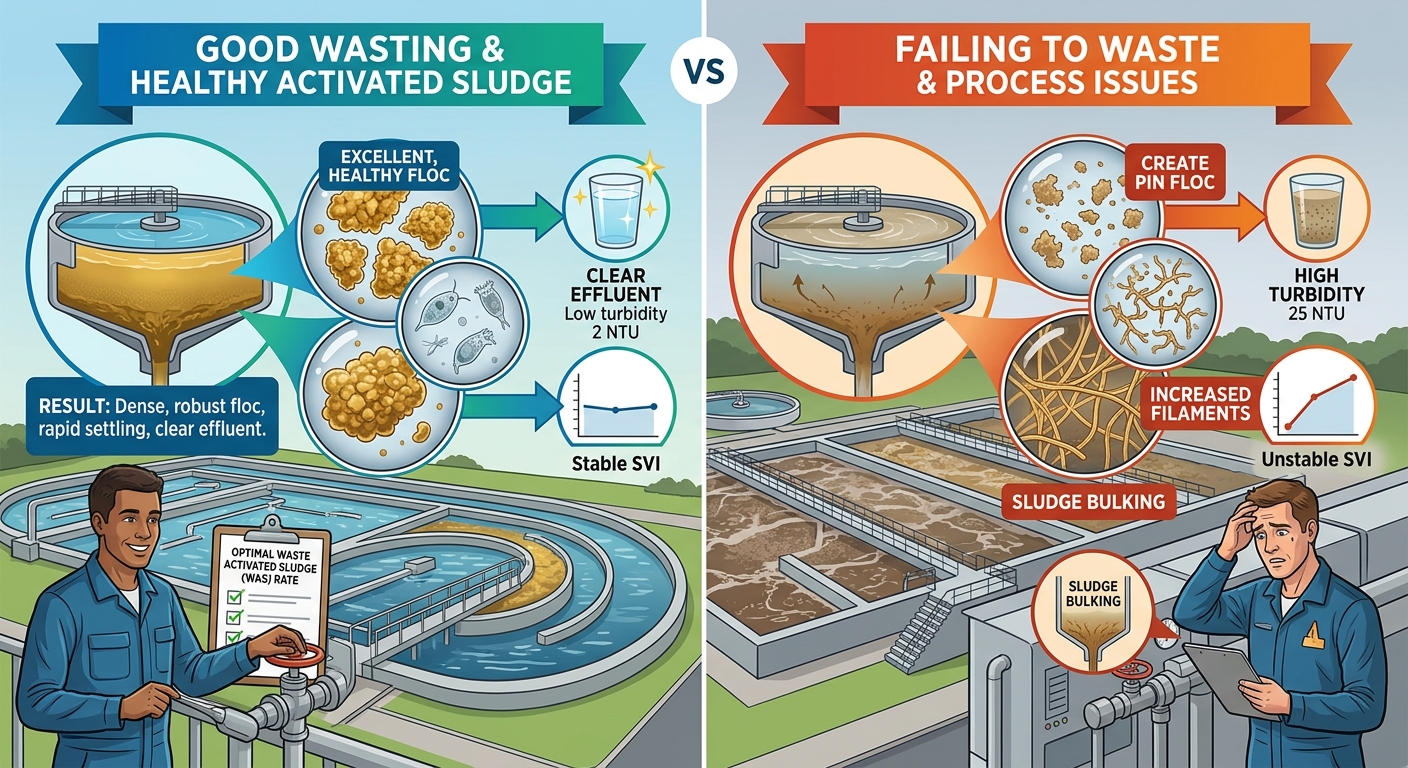
Wasting is more than a solids-handling task—it one of the primary controls in activated sludge systems. Each wasting decision affects solids retention time (SRT), food-to-microorganism ratio (F/M), microbial selection, oxygen demand, nitrification reliability, secondary clarifier loading, and effluent quality. Plants that waste on a consistent, data-driven schedule typically see steadier blankets, fewer settling surprises, faster recovery from upsets, and better control of long-term sludge age drift.
Keep SRT in the Target Operating Range
Solids retention time controls the biological character of the aeration basin. It influences the balance between fast-growing heterotrophs, nitrifiers, extracellular polymeric substance (EPS) production, endogenous respiration, and inert solids accumulation. When wasting is irregular, SRT can drift outside the intended process window before the symptoms become obvious in the clarifier or lab data.
- SRT drifts upward
- The active fraction of biomass drops
- Oxygen demand increases
- Clarifier blankets rise
- Nitrification becomes sluggish
A steady wasting program keeps SRT aligned with the plant’s permit requirements, seasonal temperatures, influent loading, and nitrification goals. That consistency gives operators a more reliable baseline for troubleshooting because changes in ammonia, turbidity, SVI, or blanket depth are easier to interpret when sludge age is not drifting uncontrolled.
Stabilize F/M to Protect Floc Strength and Effluent Clarity
The food –to –microorganism ratio is directly affected by wasting. If wasting slows, MLSS often climbs and F/M falls. At very low F/M, the biomass can move toward old-sludge conditions where bacteria rely more heavily on endogenous respiration and floc structure begins to suffer.
- Microbes consume their own EPS
- Flocs weaken and shear
- Effluent turbidity increases
- Pin floc becomes common
- Settling slows and blankets fluff
Routine wasting helps maintain enough substrate pressure to support dense, well-formed floc while avoiding excess solids inventory. For operators, the payoff is practical: clearer effluent, more predictable settling tests, and fewer clarifier problems caused by weak or dispersed biomass.
Limit Filament Advantage Before Bulking Takes Hold
Many filamentous organisms gain a competitive advantage when sludge age is allowed to extend, substrate becomes limiting, or mixed liquor conditions favor low-F/M growth. Once filaments dominate the floc structure, settling problems may persist even after process changes begin.
- Type 0092 and Microthrix increase
- Floc formers lose ground
- Sludge becomes open, stringy, and slow to compact
- Clarifier capacity shrinks
Controlled wasting does not replace microscopy, nutrient balancing, dissolved oxygen control, or selector operation, but it does help prevent the long sludge age conditions that often allow filaments to gain ground. Maintaining a consistent wasting rate gives the plant a better chance of correcting filament trends before they become a secondary clarifier capacity issue.
Manage Mixed Liquor Composition for Predictable Settling
Settling performance depends on mixed liquor composition, not MLSS concentration alone. Wasting influences the relationship between active biomass, EPS, inert material, adsorbed organics, inorganic solids, and floc density. Two basins can have the same MLSS and behave very differently if their sludge age and solids composition are different.
- EPS levels
- Active biomass fraction
- Inert buildup
- Adsorbed organics and inorganics
Too little wasting can increase inert fraction, deplete usable EPS, weaken floc, and raise blanket risk. Too much wasting can drive the system toward young sludge conditions, excess dispersed growth, poorer compaction, and reduced nitrification capacity.
The target is not “more wasting” or “less wasting”—it is the wasting rate that maintains the right solids inventory for the plant’s loading, mode of operation, season, and discharge objectives.
Make Incremental Changes—Avoid Large Process Swings
Activated sludge systems rarely respond instantly to a wasting change. Depending on temperature, loading, nitrification requirements, basin configuration, and solids inventory, it may take several days for the microbial community and clarifier behavior to reflect the new operating point.
Large, sudden wasting changes can:
- Shock the biomass
- Disrupt nitrification
- Cause temporary effluent deterioration
- Trigger filament rebounds
Instead of making large corrections based on one poor settling test or one high blanket reading, operators should adjust wasting in measured steps and evaluate trends across the data that matter most:
- MLSS / MLVSS
- SRT
- F/M
- Settling rate / SVI
- Clarifier blanket depth
- Ammonia and turbidity
Small, steady changes protect the biomass while moving the process toward the desired SRT and solids inventory. This approach also makes it easier to separate the effect of wasting from other variables such as DO control, return activated sludge (RAS) rate, influent loading, temperature, and sidestream impacts.