November 3, 2026 · Erik Rumbaugh
Measuring Influent Strength: Why BOD₅, COD, and TOC Tell Different Stories
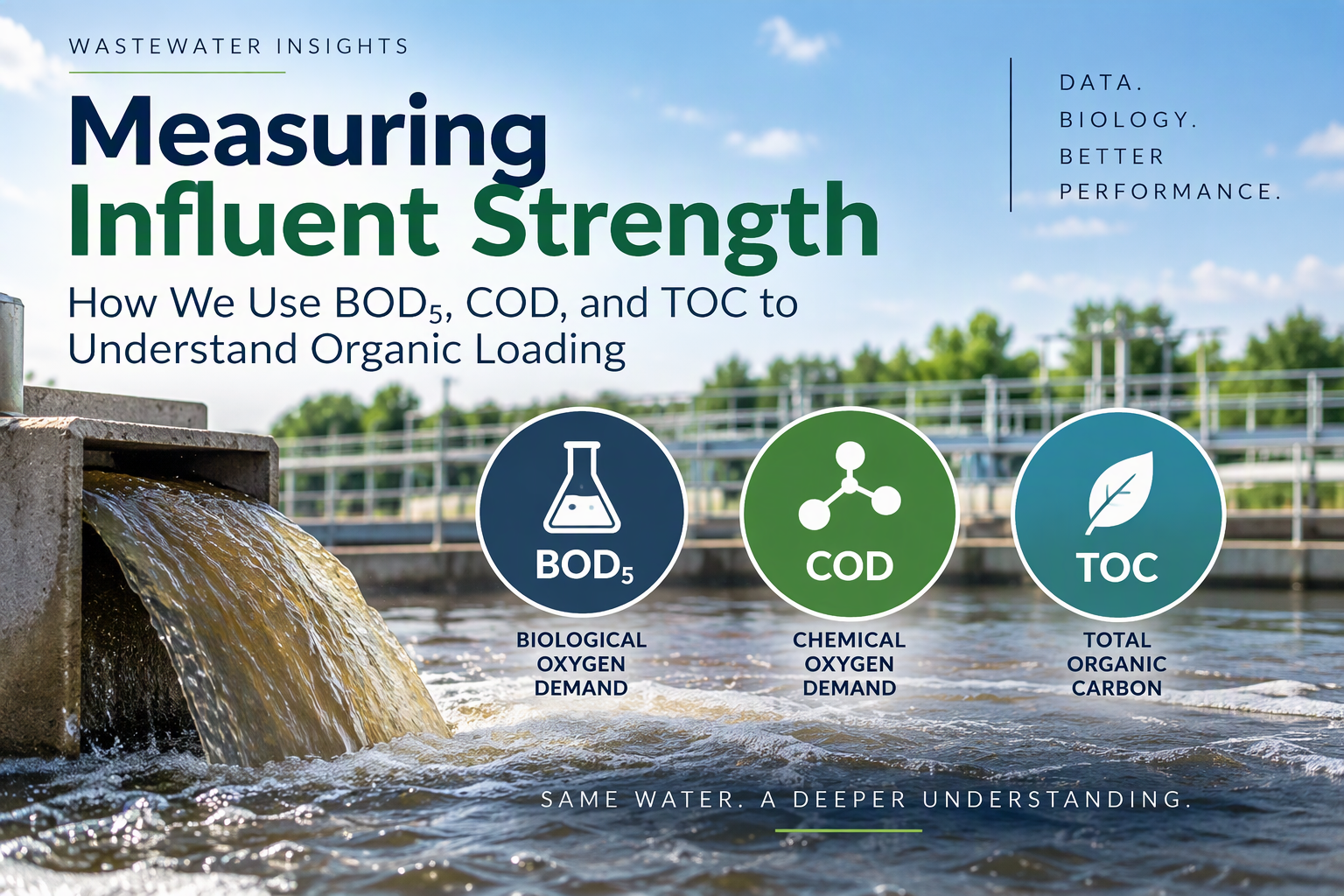
One of the most basic questions in wastewater treatment is:
How strong is the influent?
The answer affects everything from oxygen demand and sludge production to F/M ratio, nutrient requirements, biomass growth, and process stability. But “influent strength” isn’t something we measure directly. Instead, we use analytical parameters as proxies for the organic material entering the treatment system.
Three of the most useful are:
- BOD₅: Biochemical Oxygen Demand
- COD: Chemical Oxygen Demand
- TOC: Total Organic Carbon
These tests all provide information about organic strength, but they are not measuring exactly the same thing. Wastewater references likewise identify BOD, COD, and TOC as common measures used to characterize organic wastewater strength
Understanding those differences is important when trying to determine what the biological treatment system is actually experiencing.
BOD₅: The Traditional Biological Measurement
BOD₅ has been one of the standard ways of describing wastewater strength for decades.
Conceptually, it asks:
How much oxygen will microorganisms consume while degrading biodegradable material during a five-day test?
This makes BOD₅ intuitively useful because biological wastewater treatment is fundamentally driven by microorganisms consuming substrates.
But BOD₅ has an important operational limitation:
You have to wait five days.
By the time an operator receives the result, the wastewater represented by that sample has long since passed through the plant. BOD₅ therefore works much better as a historical characterization or compliance parameter than as a real-time process-control measurement. Published wastewater references similarly point to the five-day analytical period as a major limitation of BOD₅ for process monitoring.
For a relatively stable municipal influent, that delay may be manageable.
For an industrial wastewater system where production schedules, cleaning cycles, spills, product losses, or batch discharges can rapidly change influent strength, five days can be an eternity.
Another Problem: Soluble BOD₅ Doesn ’t Tell the Whole Story
When soluble BOD₅ is being used as the organic-loading proxy, there is another important limitation.
It preferentially tells us about the biodegradable material already present in the soluble fraction. But wastewater can also contain substantial amounts of organic material associated with suspended or colloidal solids.
Some of that material can still become biologically available.
It simply takes longer.
Particulate and complex organics may first require extracellular enzymatic breakdown and hydrolysis before microorganisms can transport and metabolize the resulting smaller compounds.
That distinction matters.
A wastewater could have a relatively modest soluble BOD₅ while still carrying a much larger reservoir of organic material that will gradually become available to the biomass.
So:
Low soluble BOD₅ does not necessarily mean low total biological loading.
COD: A Broader Look at Oxygen Demand
COD provides another perspective.
Instead of relying on microorganisms to oxidize organic material, COD uses chemical oxidation to quantify oxygen demand. COD can also be fractionated into total and dissolved components, providing additional information about the nature of the incoming material.
For process monitoring, COD has a major advantage over BOD₅: speed. Laboratory COD methods can provide results in hours rather than days.
That makes COD particularly valuable when influent conditions change rapidly.
But COD has its own limitation.
Not everything measured as COD is necessarily biologically available.
COD can include readily biodegradable material, slowly biodegradable material, and organic material that may be poorly biodegradable or essentially inert under the conditions in the treatment system.
Therefore, COD often gives us a broader picture of organic loading, but not necessarily a direct measurement of the food immediately available to the biomass.
TOC: Measuring Carbon Directly
TOC approaches the question differently again.
Rather than expressing organic strength in terms of oxygen demand, TOC measures the amount of organic carbon present in the sample. Wastewater testing guidance identifies TOC alongside BOD and COD as a primary analytical approach for characterizing organic wastewater strength.
That can make TOC valuable for trending influent strength, particularly when wastewater composition is reasonably consistent.
But, like COD, TOC does not inherently tell us whether that carbon is:
- readily biodegradable,
- slowly biodegradable, or
- biologically resistant.
A carbon atom is counted regardless of how quickly, or whether, the biological system can metabolize the molecule containing it.
Think in Terms of Organic Fractions
This is where interpretation becomes more useful than simply looking at a laboratory number.
The organic load entering a biological treatment system can conceptually be divided into fractions:
Readily biodegradable organics
Small, soluble compounds that microorganisms can consume relatively quickly.
Slowly biodegradable organics
Larger molecules, colloids, and particulate material that must undergo hydrolysis or other transformations before organisms can readily use them.
Non-biodegradable or inert organics
Material contributing to COD or TOC but providing little usable substrate to the biological population.
This helps explain why BOD₅, COD, and TOC results do not necessarily move together.
They are looking at overlapping, but different, portions of the wastewater.
Concentration Isn ’t the Same as Loading
There is another distinction operators should keep in mind.
A concentration tells us how strong the wastewater is:
mg/L
But the treatment system experiences a mass loading.
Conceptually:
Organic load = concentration × flow
This means a 20% increase in COD concentration doesn’t necessarily represent a 20% increase in plant loading if flow changed significantly at the same time.
When assessing influent strength, therefore, we should ideally look at both concentration and calculated mass loading.
That is especially important when using organic measurements in F/M calculations or when evaluating changes in aeration demand and biological activity.
The Value Is in Using the Tests Together
Rather than asking which test is “best,” a better question is:
What part of the influent organic load is each test showing us?
BOD₅
Provides information about biologically oxidizable material, but suffers from a five-day reporting delay and, when soluble BOD₅ is used, does not represent particulate and colloidal organic fractions.
COD
Provides a much faster and generally broader indication of oxidizable material, but includes material that may not actually be biodegradable.
TOC
Provides a direct measurement of organic carbon, but doesn’t tell us how biologically available that carbon is.
Used together, these measurements can tell a much richer story than any one parameter alone.
Ratios Can Be Particularly Informative
Once enough historical data have been collected, relationships between the parameters can become useful process indicators.
For example:
BOD₅/COD
can provide information about the relative biodegradable character of the wastewater. COD/BOD₅ is also commonly used as a screening indicator of wastewater composition and test response.
Similarly:
COD/TOC
can become a useful fingerprint of wastewater composition.
The important point is not necessarily establishing a universal “good” ratio. It is establishing what is normal for your particular wastewater.
If a facility normally operates within a relatively narrow COD:TOC or BOD₅:COD relationship and that relationship suddenly changes, something in the influent may have changed even if the individual concentrations don’t initially appear remarkable.
Moving From “How Strong?” to “What Kind of Food?”
Ultimately, biological wastewater treatment isn’t driven simply by a laboratory BOD₅ number.
The microbial community experiences a mixture of substrates with very different characteristics and degradation rates.
That is why influent characterization should move beyond:
“ What is our BOD?”
toward questions such as:
How much organic material is entering the plant?
How much is soluble versus particulate?
How much appears readily biodegradable versus slowly biodegradable?
How much of the COD or TOC may be biologically unavailable?
And is the composition of that loading changing over time?
BOD₅, COD, and TOC each provide a different window into those questions. The real value comes from interpreting them together and relating those measurements back to flow, biological activity, oxygen demand, and plant performance.
Bottom line
BOD₅ tells us something about what the biology can consume. COD tells us more about the total oxidizable burden. TOC tells us how much organic carbon is present. None tells the entire story by itself.
For operators trying to understand influent strength, the goal shouldn’t simply be collecting another laboratory number. It should be developing a clearer picture of how much organic material is entering the system, what form it is in, and how the biomass is likely to respond to it.