November 20, 2026 · Erik Rumbaugh
What Happens to an Anaerobic Digester Without Methanogenic Archaea?
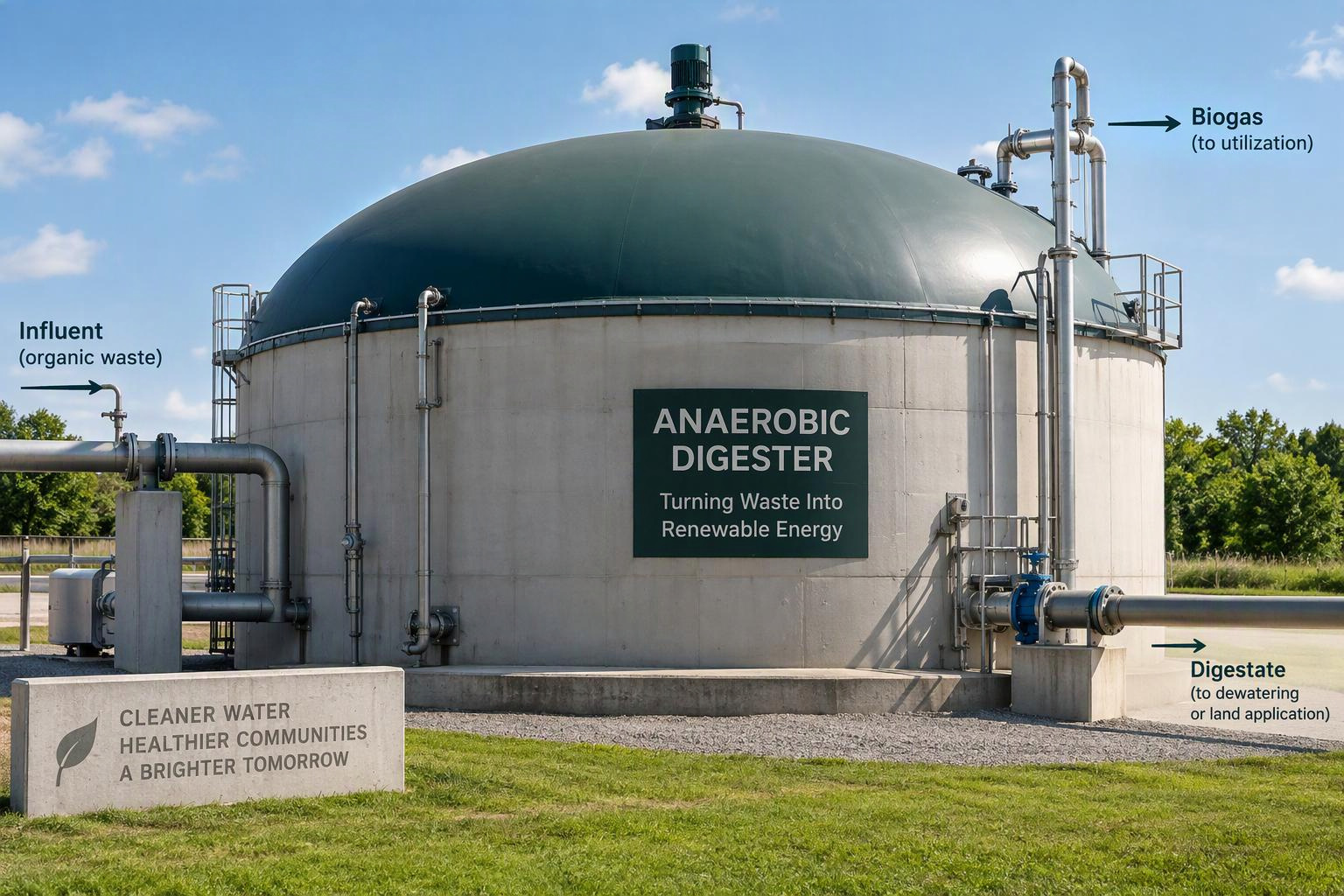
Anaerobic digestion depends on a complex microbial community working together to convert organic waste into stabilized solids and methane. Among the most important members and least understood of this community are methanogenic archaea.
Without active methanogens, an anaerobic digester may continue breaking down organic material temporarily, but the microbial food chain is effectively broken at its final step. Methane production declines, volatile fatty acids (VFAs) accumulate, alkalinity is consumed, and eventually the digester can sour.
The lesson is simple: stable anaerobic digestion depends on maintaining the right microbial populations in balance.
Anaerobic Digestion Is a Microbial Assembly Line
Anaerobic digestion occurs through four interconnected biological stages:
Hydrolysis → Acidogenesis → Acetogenesis → Methanogenesis
During hydrolysis , bacteria break proteins, carbohydrates, and fats into smaller soluble compounds. Acidogenic bacteria then ferment these compounds into VFAs, alcohols, hydrogen, carbon dioxide, and other intermediates.
Next, acetogenic microorganisms convert compounds such as propionate and butyrate toward acetate, hydrogen, and carbon dioxide.
Finally, methanogenic archaea complete the process.
Two particularly important pathways are acetoclastic methanogenesis , which uses acetate to produce methane, and hydrogenotrophic methanogenesis , which uses hydrogen and carbon dioxide.
Methanogens therefore do much more than produce biogas. By continuously consuming metabolic end products, they help maintain conditions that allow upstream microbial populations to function efficiently.
What Happens When Methanogens Are Inhibited?
When methanogenic activity declines, the effects can propagate throughout the digester.
Methane Production Falls
The most obvious symptom is reduced methane production. The upstream bacterial community can continue fermenting organic material for some time, but downstream conversion becomes increasingly limited.
Declining methane production may therefore indicate that the microbial balance within the digester is changing.
Hydrogen Creates a Metabolic Bottleneck
Hydrogenotrophic methanogens normally consume hydrogen and help maintain a low hydrogen partial pressure.
This is critical because acetogenic bacteria depend on low hydrogen conditions to make certain metabolic reactions favorable.
If hydrogen-consuming methanogens become inhibited, hydrogen can accumulate. Conversion of propionate and butyrate becomes less favorable, and intermediate organic acids begin to accumulate.
This creates a microbial bottleneck:
Methanogen inhibition → reduced hydrogen consumption → impaired acetogenesis → VFA accumulation
VFAs Rise and the Digester Begins to Sour
As methane production and syntrophic metabolism become disrupted, acetate, propionate, butyrate, and other fermentation products can accumulate.
Initially, the digester’s bicarbonate alkalinity buffers these acids, meaning pH may remain relatively stable even though the biological process is already becoming stressed.
As VFA accumulation continues, alkalinity is consumed. Eventually the buffering capacity is overwhelmed and pH begins to decline.
This creates a damaging feedback loop:
Methanogen inhibition → VFA accumulation → alkalinity depletion → declining pH → further methanogen inhibition
If the condition continues, hydrolytic, fermentative, and acetogenic microorganisms may also become inhibited, resulting in poor volatile solids destruction, increased residual COD, odors, and poorly stabilized sludge.
Why Operators Should Look Beyond pH
Because alkalinity initially buffers accumulating acids, pH alone may not provide adequate early warning of digester instability.
Tracking VFA and alkalinity together , along with methane production, organic loading, temperature, pH, and solids retention, provides a much better picture of biological health.
Methanogenic activity can be disrupted by organic overloading, temperature changes, inhibitory compounds, ammonia or sulfide stress, pH changes, and inadequate retention time.
However, conventional process measurements primarily show the symptoms of these problems. They do not always reveal how the microbial community itself has changed.
Looking Inside the Digester with Environmental Genomics
Aster Bio’s Environmental Genomics testing provides another layer of information by characterizing the microbial community responsible for digestion.
Microbial community data can help evaluate populations associated with methanogenesis, fermentation, syntrophic fatty-acid degradation, hydrolysis, sulfur cycling, and other important anaerobic functions.
When combined with VFA, alkalinity, pH, methane production, loading, and temperature data, molecular analysis can provide a more complete picture of digester health.
Ultimately, the question isn’t simply:
“ How much biomass is in the digester?”
It is:
“ Do we have the right microorganisms, in the right balance, performing the right functions?”
The chemistry tells us something is changing.
The microbiology can help explain why.