November 13, 2026 · Erik Rumbaugh
Archaea in Wastewater Treatment: Separating Industry Hype from Sequencing Reality
Several years ago, a wave of marketing swept through the wastewater industry promoting archaea as a superior alternative to bacteria for biological treatment. Proponents argued that because archaea are famous for surviving extreme environments, seeding treatment plants with archaeal cultures would deliver faster BOD removal, better shock-load resilience, and superior nutrient removal compared to conventional bacterial biomass.
For plant operators and process engineers, those claims raised two practical questions: Are archaea actually common in wastewater treatment systems, and when they are present, what roles do they play?
At Aster Bio, we have screened microbial communities across a wide range of aerobic and anaerobic wastewater systems using DNA sequencing. When we look at the actual genomic data rather than sales brochures, a very clear—and highly compartmentalized—picture emerges.
Where the Archaea Hype Came From
Archaea represent an entirely separate domain of single-celled life from bacteria, possessing distinct cell membrane lipids and metabolic pathways. Because early microbiologists first isolated archaea from extreme habitats—such as hydrothermal vents, hypersaline lakes, and acidic hot springs—they earned a reputation as nature’s toughest extremophiles.
Marketers extrapolated that reputation into wastewater treatment, pitching archaea as “super-microbes” capable of outperforming standard activated sludge under temperature swings, high salinity, or toxic influent spikes. Around the same time, academic researchers discovered Ammonia-Oxidizing Archaea (AOA) thriving in open oceans and low-nutrient soils, sparking speculation that archaea might also be the hidden drivers of nitrification in municipal and industrial treatment plants.
What Aster Bio’s Sequencing Data Actually Shows
When we evaluate mixed liquor and biosolids samples across full-scale facilities, archaeal abundance depends entirely on whether oxygen is present:
-
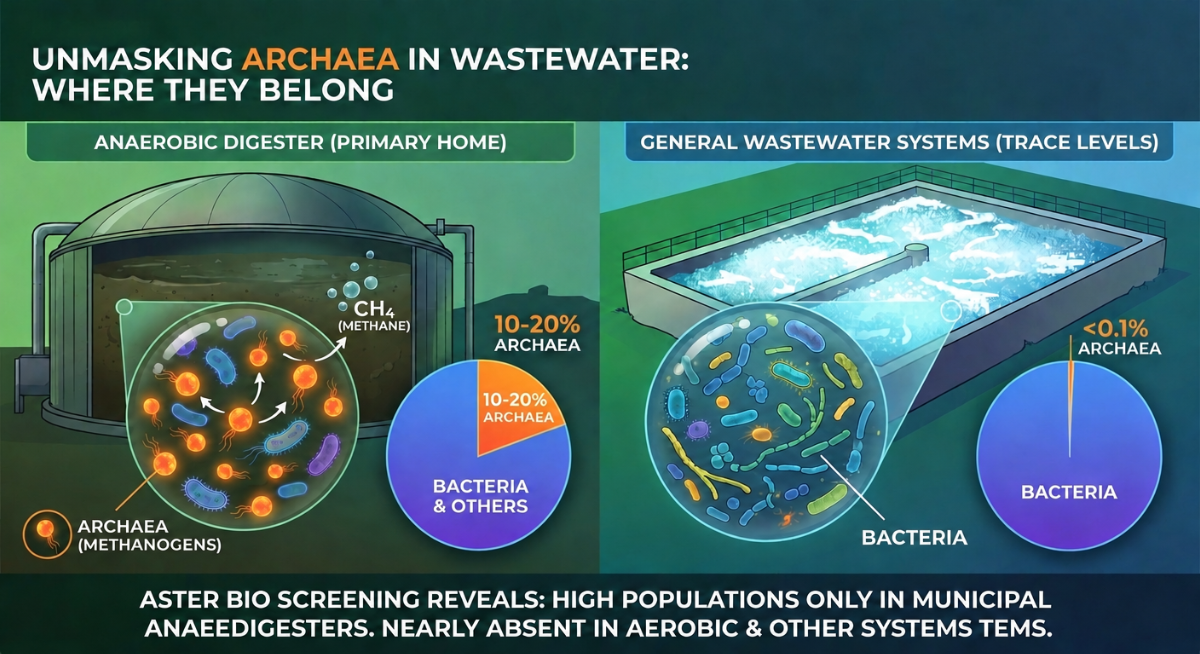
Anaerobic Digesters: The only engineered wastewater environment where Aster Bio consistently detects significant populations of archaea is inside anaerobic digesters. In healthy municipal anaerobic digesters, archaea typically represent 10% to 20% of total sequencing reads.
-
Non-Digester Systems (0% to <0.1% of total reads): Across conventional aerobic and anoxic treatment processes—including activated sludge basins, oxidation ditches, sequencing batch reactors (SBRs), and aerated lagoons—archaea are virtually absent. Our screening routinely shows anywhere from undetectable levels (0%) to less than 0.1% of total reads.
In open, aerated wastewater basins, fast-growing heterotrophic bacteria and specialized nitrifying bacteria simply outcompete archaea for organic carbon, ammonia, and oxygen.
When Archaea Are Present, What Roles Do They Play?
While archaea are not workhorses in your aeration basin, the populations that do establish themselves in specific treatment niches perform critical—or highly specialized—biochemical functions.
1. Methanogenesis in Anaerobic Digesters (Essential)
In anaerobic digesters, that 10–20% archaeal population consists of methanogens —strict anaerobes that carry out the final, rate-limiting step of anaerobic digestion.
Anaerobic digestion is a tightly linked microbial relay race:
- Bacteria handle the first three stages—hydrolysis, acidogenesis, and acetogenesis—breaking down complex fats, proteins, and carbohydrates into volatile fatty acids (VFAs), acetate, hydrogen, and carbon dioxide.
- Methanogenic archaea (such as acetoclastic Methanosaeta and Methanosarcina , alongside hydrogenotrophic methanogens) consume that acetate and to produce methane.
Without archaea, the digestion chain stalls. Volatile fatty acids accumulate, digester pH crashes, volatile solids reduction drops, and biogas production halts. In this environment, archaea are not optional—they are indispensable.
2. Trace Nitrification in Low-Ammonia Niches (Minor)
When trace reads (<0.1%) of archaea appear in aerobic or tertiary wastewater systems, they are most often Ammonia-Oxidizing Archaea (AOA). AOA possess a high affinity for ammonia, which gives them an ecological advantage in oligotrophic (nutrient-poor) environments like seawater, groundwater, or tertiary polishing filters.
However, municipal and industrial wastewater influents contain relatively high ammonia concentrations that strongly favor Ammonia-Oxidizing Bacteria (AOB) and comammox Nitrospira. Even when AOA are detectable at trace levels in activated sludge, bacteria do the overwhelming majority of the nitrification work.
Practical Takeaways for Wastewater Operators
Understanding where archaea actually live—and what they do—helps facilities spend their operational and bioaugmentation budgets wisely:
-
Skip “all-purpose archaea” additives for aerobic basins: Dosing an aerated activated sludge system with methanogenic archaea is counterproductive; dissolved oxygen is directly toxic to methanogens, and bacteria will always dominate aerobic BOD removal and nitrification.
-
Protect and monitor your digester archaea: In anaerobic systems, that 10–20% archaeal community is your primary engine for biogas generation and sludge stabilization. Because methanogens reproduce much more slowly than acid-forming bacteria and are sensitive to pH drops, ammonia inhibition, and temperature swings, monitoring their relative abundance and balance via DNA profiling provides an early warning sign long before a digester goes sour.
At Aster Bio, our goal is to replace guesswork with direct biological measurement. Whether you are troubleshooting a sluggish aeration basin or optimizing methane yield in an anaerobic digester, knowing which organisms are actually doing the work—and in what proportions—remains the most reliable path to stable, cost-effective treatment.