November 28, 2026 · Erik Rumbaugh
Nitrobacter vs. Nitrospira: Understanding Nitrifier Ecology in Wastewater Treatment
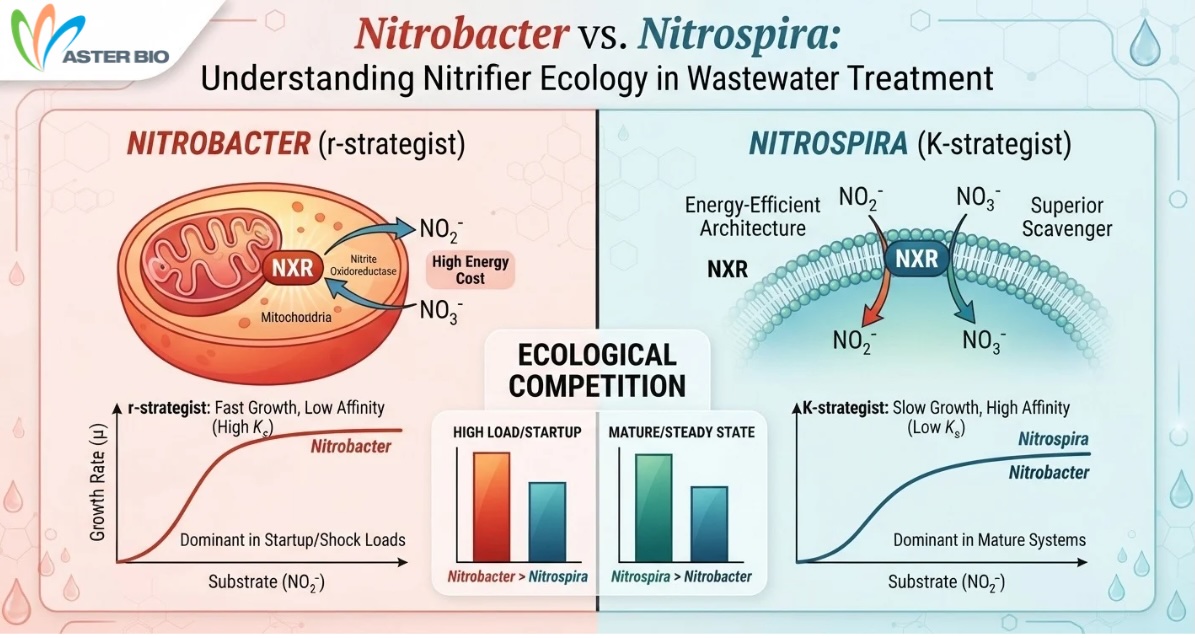
In biological wastewater treatment, achieving consistent nitrification requires more than simply maintaining dissolved oxygen and alkalinity—it depends on the specific microbial community driving the process. For decades, textbooks taught that Nitrosomonas converts ammonia to nitrite, and Nitrobacter converts nitrite to nitrate.
However, modern molecular diagnostics (such as qPCR and 16S rRNA sequencing) have revealed a different reality in full-scale treatment plants. In mature, healthy biological systems, Nitrospira —not Nitrobacter —is almost always the dominant nitrite-oxidizing bacteria (NOB).
Understanding the ecological competition between Nitrospira and Nitrobacter gives operators and engineers a powerful diagnostic lens into reactor health, startup dynamics, and recovery from upset events.
The r -Strategist vs. The K -Strategist
The rivalry between Nitrobacter and Nitrospira is a textbook example of ecological r/K selection theory playing out inside an aeration basin or biofilter:
- Nitrobacter (r -strategist): Built for speed and opportunity. When nitrite and oxygen are abundant, Nitrobacter divides rapidly. However, it is inefficient when resources become scarce.
- Nitrospira (K -strategist): Built for efficiency and survival. Nitrospira grows slowly, but its cellular machinery is optimized to scavenge trace amounts of nitrite and oxygen that Nitrobacter cannot access.
| Parameter | Nitrospira | Nitrobacter |
|---|---|---|
| Ecological Strategy | ** K**-strategist (efficiency-focused) | r-strategist (growth-focused) |
| Nitrite Affinity ( |
High affinity (~0.1–0.5 mg N/L) | Low affinity (~1–5 mg N/L) |
| Maximum Growth Rate ( |
Slow (~0.3–0.5 |
Fast (~0.8–1.4 |
| Dissolved Oxygen Affinity | High (active below 1.0 mg/L DO) | Low (requires > 2.0 mg/L DO) |
| Free Ammonia ( |
Sensitive (inhibited at 0.04–0.5 mg/L) | Resilient (tolerates 1–5+ mg/L) |
| Primary Niche | Mature activated sludge, RAS, biofilms | Startup reactors, shock loads, high-strength waste |
Why Nitrospira Dominates Mature, Healthy Systems
When a wastewater plant operates at steady state with a healthy Solids Retention Time (SRT), Nitrospira outcompetes Nitrobacter through three primary advantages:
-
Superior Enzyme Architecture: Nitrospira anchors its nitrite-oxidizing enzyme (NXR) on the outside (periplasmic side) of its inner cell membrane. This generates cellular energy directly without spending ATP to transport nitrite into the cell and nitrate back out. Nitrobacter ‘s enzyme faces inward, giving it a higher energy overhead per mole of nitrite oxidized.
-
Scavenging at Trace Concentrations: In a balanced system, ammonia-oxidizing bacteria (AOB) and NOB work in tight syntrophy, keeping bulk nitrite levels near zero (< 0.1–0.2 mg
-N/L). Because Nitrospira has a much lower half-saturation constant (
), it thrives on trace nitrite while effectively starving Nitrobacter.
-
Micro-Zone Oxygen Efficiency: Mature biological flocs and biofilms develop steep oxygen diffusion gradients. Nitrospira possesses a much higher affinity for dissolved oxygen, allowing it to remain active deeper inside flocs and biofilters where Nitrobacter becomes oxygen-limited.
When Nitrobacter Takes Over: High Ammonia and Startup Conditions
If Nitrospira is so efficient, why does Nitrobacter still exist in wastewater systems? Because steady-state conditions don’t last forever.
Consider a system experiencing high ammonia concentrations and limited nitrifying biomass —such as a reactor startup, recovery after a toxic shock, or an industrial high-strength slug load. As the limited AOB population begins oxidizing the abundant ammonia, nitrite accumulates in the bulk liquid faster than the small NOB population can consume it.
In this high-nitrite, high-ammonia environment, the competitive landscape flips completely:
- Monod Kinetics Favor Speed: Once nitrite climbs well above both organisms’
thresholds (> 2–5 mg/L), substrate affinity no longer matters. Growth is governed purely by maximum growth rate (
), allowing Nitrobacter to double two to four times faster than Nitrospira.
- Free Ammonia Suppression: High total ammonia—especially at elevated pH and temperature—produces unionized Free Ammonia (
). Nitrospira is highly sensitive to free ammonia and shuts down quickly, whereas Nitrobacter tolerates significantly higher concentrations and continues oxidizing nitrite.
Operational Takeaways for Plant Management
Tracking the balance between Nitrospira and Nitrobacter offers actionable guidance for process control and bioaugmentation:
-
During High-Ammonia Upsets or Startups: Expect Nitrobacter to do the heavy lifting first. Because Nitrobacter has a lower affinity for oxygen, keep Dissolved Oxygen elevated (> 2.5–3.0 mg/L) and monitor pH to prevent free ammonia toxicity while the system clears the nitrite peak.
-
Transitioning to Steady State: Once nitrite falls below 0.5 mg/L and SRT is maintained above 10–15 days, Nitrospira will naturally re-establish as the dominant NOB, allowing you to optimize aeration energy at lower DO setpoints.
-
Diagnostic Value: Using qPCR to measure Nitrospira versus Nitrobacter ratios provides an early-warning indicator of system stability—a sudden shift toward Nitrobacter signals recent nitrite accumulation, SRT washout, or inhibitory stress even after effluent numbers appear to recover.
Need deeper insight into your biological system?
At Aster Bio , we combine molecular diagnostics (qPCR and next-generation sequencing) with targeted bioaugmentation and process engineering to help wastewater operators diagnose nitrification bottlenecks and build resilient biomass. Contact our team to evaluate your reactor’s microbial community.