October 15, 2026 · Erik Rumbaugh
Cyanide in Biological Treatment Systems: Disruption, Detoxification, and Microbial Resilience
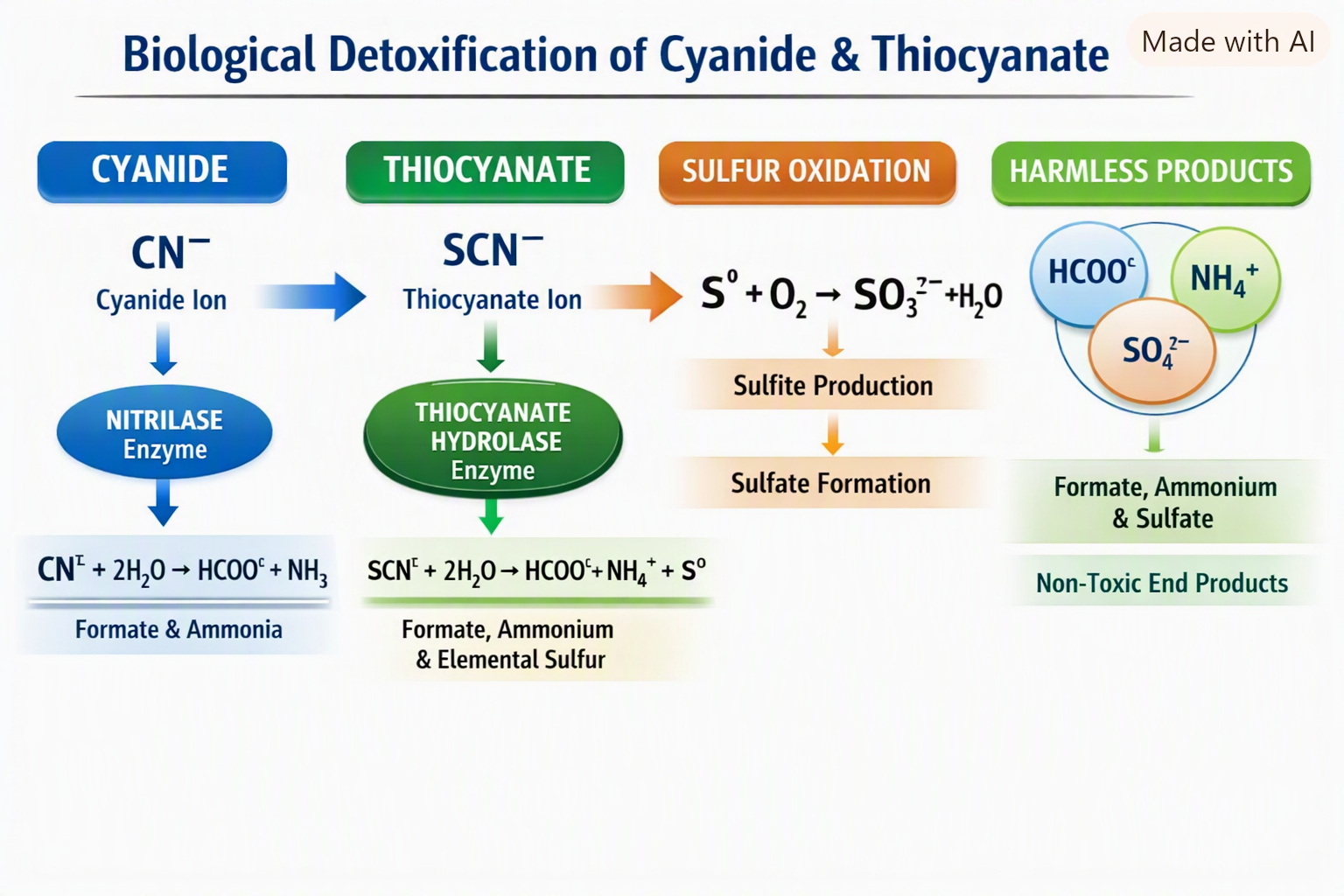
Cyanide-bearing wastewater is common in refining, petrochemical, mining, and metal-finishing operations—and even low concentrations can disrupt biological treatment. Cyanide can inhibit key microbial processes, destabilize activated sludge, and increase the risk of effluent permit violations.
The same biological system that is vulnerable to cyanide can also become part of the solution. Many industrial activated sludge communities contain organisms that transform cyanide and thiocyanate into less toxic, more treatable compounds. When loading, aeration, solids retention time, pH, and alkalinity are properly managed, acclimated biomass can provide reliable biological detoxification.
1. How Influent Cyanide Disrupts Biological Treatment
A. Direct Enzyme Inhibition
Cyanide binds to metal centers in respiratory enzymes—particularly cytochrome oxidase—and interrupts electron transport. As microbial respiration declines, sensitive populations such as nitrifiers, filamentous bacteria, and many heterotrophs can lose metabolic activity within minutes. Operators may first detect the upset through a sudden decrease in oxygen uptake, followed by declining treatment performance.
Operational symptoms:
- Sudden drop in DO uptake rate
- Loss of nitrification
- Rising ammonia and nitrite
- Reduced COD removal
B. Nitrification Collapse
Ammonia-oxidizing bacteria (AOB) and nitrite-oxidizing bacteria (NOB) are among the most cyanide-sensitive organisms in activated sludge. Free cyanide concentrations as low as 0.1–0.3 mg/L can inhibit nitrification, causing ammonia oxidation to slow first and allowing ammonia or nitrite to break through in the final effluent.
Consequences:
- Elevated ammonia in final effluent
- Nitrite breakthrough
- Increased chlorine demand downstream
C. Sludge Deflocculation and Settling Problems
Cyanide can disrupt the production of extracellular polymeric substances (EPS), weakening floc structure and reducing solids capture in secondary clarification. The resulting deterioration may appear as pin floc, turbid effluent, rising total suspended solids, or increased polymer demand.
Symptoms:
- Pin floc
- Turbid secondary effluent
- Rising TSS
- Higher polymer demand in clarification
D. Denitrification Inhibition
Denitrifiers are more tolerant than nitrifiers, but cyanide still slows nitrate reduction and destabilizes anoxic zones.
Results:
- Elevated nitrate in effluent
- Poor nitrogen removal
- Increased internal recycle load
2. How Microorganisms Detoxify Cyanide and Thiocyanate
Despite cyanide’s toxicity, many industrial biomass communities contain organisms capable of transforming cyanide into less harmful compounds. These pathways are well documented in refinery, coking, and gasification wastewater systems.
A. Cyanide → Cyanate → Ammonium + CO₂
Several heterotrophic bacteria use cyanide hydratase or cyanide oxygenase pathways to transform free cyanide into cyanate (CNO⁻). Cyanate is then hydrolyzed to ammonium and carbon dioxide, reducing cyanide toxicity while transferring the nitrogen load to downstream nitrification.
Key genera:
- Paracoccus
- Comamonas
- Bacillus
- Azoarcus
These organisms tolerate moderate cyanide loads and often proliferate in refinery activated sludge.
B. Thiocyanate (SCN⁻) → Sulfate + Ammonium
Thiocyanate is common in refinery wastewater from hydroprocessing, coking, and sulfur recovery operations. Specialized sulfur-oxidizing bacteria transform SCN⁻ into sulfate and ammonium through thiocyanate dehydrogenase and cyanate hydratase pathways. This conversion increases oxygen, alkalinity, and downstream nitrogen-treatment requirements.
Dominant SCN oxidizers:
- Thiobacillus
- Sulfuritalea
- Hyphomicrobium
These organisms thrive in systems with stable aeration, moderate SRT, and sufficient alkalinity.
C. Ammonium Removal via Nitrification/Denitrification
Biological oxidation of cyanide and thiocyanate does not complete nitrogen removal; it converts the compounds into ammonium that must still be nitrified and, where required, denitrified. The system therefore has to support detoxifying organisms and protect nitrifiers from cyanide inhibition at the same time.
A healthy detoxifying system typically includes:
- AOB/NOB (Nitrosomonas , Nitrospira)
- Denitrifiers (Thauera , Denitratisoma , Paracoccus)
D. Aromatic and Petrochemical Co-Metabolism
Refinery biomass often includes organisms such as Thauera , Novosphingobium , and Immundisolibacter that degrade phenolic and aromatic compounds. By reducing competing organic loads and helping stabilize carbon availability and redox conditions, these populations can indirectly support cyanide and thiocyanate detoxification.
3. What Makes a Biological System Capable of Cyanide Detoxification?
A. Acclimation
Acclimation allows cyanide- and thiocyanate-degrading populations to increase over days to weeks. Gradually increasing the influent load—and avoiding abrupt concentration or mass-loading spikes—gives these organisms time to proliferate without overwhelming nitrifiers and other sensitive populations. Where a faster startup or recovery is needed, bioaugmentation with a compatible, proven culture can help establish the required degraders and reduce the time needed for acclimation. Plants should confirm culture compatibility with site-specific wastewater conditions and continue controlled loading and process monitoring after addition.
B. SRT Control
A solids retention time of 12–20 days can support slower-growing sulfur oxidizers and cyanide degraders, helping the system retain the organisms needed for detoxification. The appropriate target should also account for temperature, loading, nitrification requirements, and site-specific settling performance.
C. Oxygen Management
Thiocyanate oxidation is oxygen-intensive, so aerobic zones must have enough oxygen-transfer capacity to accommodate both baseline treatment demand and the additional SCN⁻ load. Maintaining dissolved oxygen above 2.0 mg/L provides an operating target, but plants should also trend oxygen uptake and aeration response as loading changes.
D. Balanced Nitrogen Cycle
Since cyanide → ammonium, nitrification must be protected. This often requires:
- Lower shock loads
- Equalization tanks
- pH control
- Supplemental alkalinity
E. Monitoring Microbial Populations
Microbial community analysis (MCA) and quantitative polymerase chain reaction (qPCR) can help plants track cyanide- and thiocyanate-degrading populations. Trending these results alongside cyanide loading, ammonia, nitrite, oxygen uptake, and solids performance can provide earlier warning of declining detoxification capacity.
4. Summary: From Disruption to Detoxification
Cyanide and thiocyanate can be biologically transformed into ammonium, sulfate, and carbon dioxide, but reliable performance depends on protecting the entire treatment train. Effective control combines influent equalization, acclimated biomass, adequate solids retention time, sufficient aeration, pH and alkalinity management, and close tracking of nitrogen and solids performance.
A well-acclimated biomass becomes:
- More resilient
- More stable
- More capable of handling refinery and petrochemical variability
Biological detoxification is not just possible — it is increasingly the preferred strategy in modern industrial wastewater treatment.
For wastewater professionals, the key is to treat cyanide detoxification as a controlled biological process rather than an incidental removal mechanism. Stable loading, adequate oxygen and alkalinity, sufficient biomass retention, and early detection of inhibition allow an acclimated system to convert a high-risk influent into a manageable treatment challenge.