June 7, 2026 · Erik Rumbaugh
When Lagoons Heat Up: Why Summer Brings Ammonia Spikes, Algae Blooms, and Odors
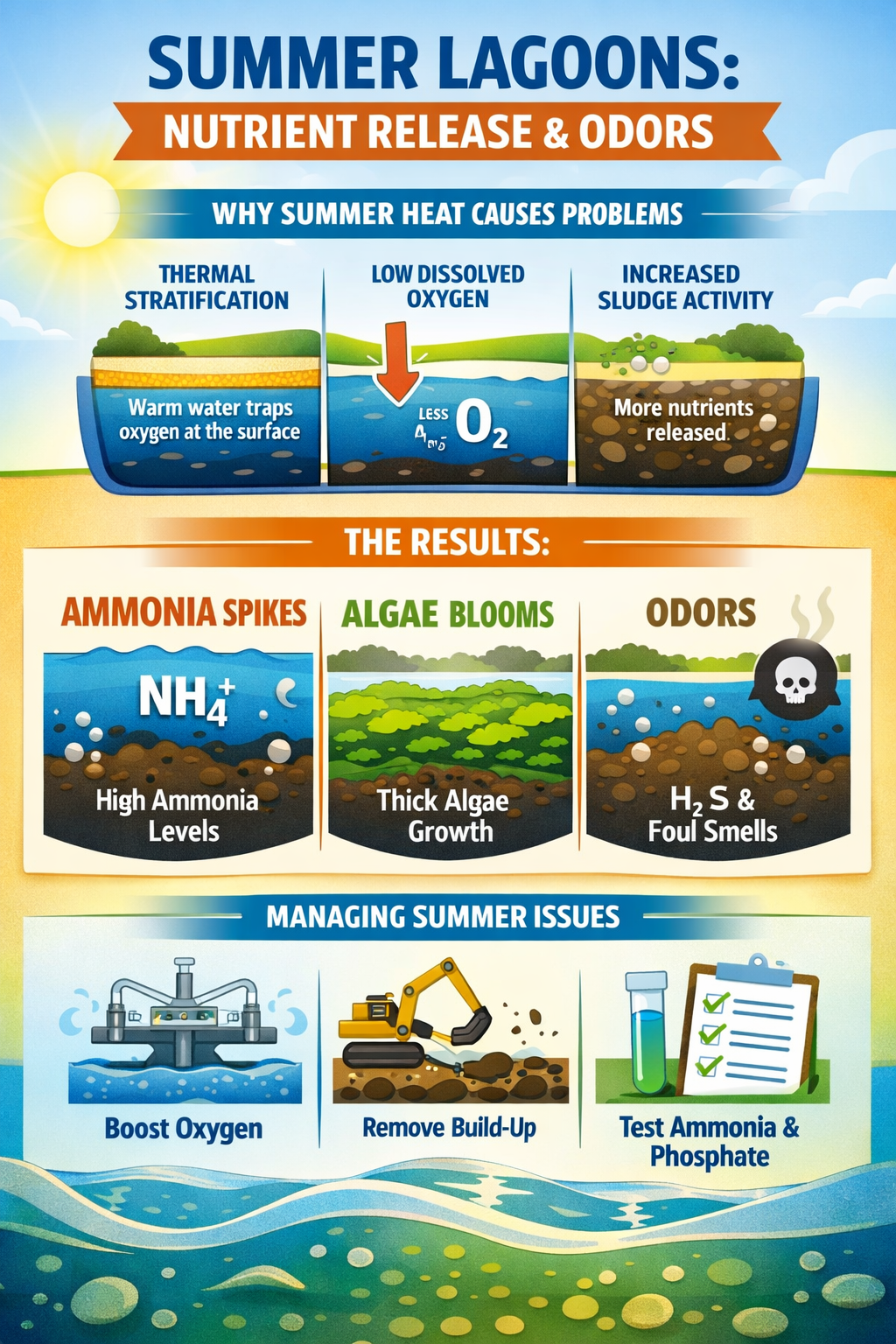
Summer heat flips lagoon biology into a completely different operating mode — and that shift drives nutrient release from sludge, ammonia spikes, algae blooms, and odor episodes. The root cause is simple: as temperatures rise, oxygen transfer drops, microbial metabolism accelerates, and the sludge layer becomes increasingly anaerobic.
Why Summer Heat Changes Everything in Lagoons
-
Thermal stratification
Warm surface water forms a stable layer over cooler bottom water. This reduces vertical mixing, traps oxygen at the top, and isolates the sludge layer. -
Lower oxygen transfer
Oxygen solubility drops by ~30% between winter and summer. Even with the same aeration horsepower, lagoons simply cannot hold as much DO. -
Accelerated microbial activity
Higher temperatures speed up biological reactions — including the breakdown of sludge, the release of nutrients, and the formation of odor compounds.
Nutrient Release from Sludge: The Summer Surge
-
Ammonia release
As the sludge layer becomes anaerobic, proteins and organic nitrogen break down into ammonium (NH₄⁺). Without oxygen, nitrifiers cannot convert it to nitrate.
Result: internal ammonia loading spikes, even if influent loading stays constant. -
Phosphate release
Under anaerobic conditions, phosphorus bound to iron and aluminum is released back into the water column. This fuels algae growth including problematic cyanobacteria (blue-green algae).
In many lagoons, 50–80% of summer ammonia and phosphate comes from sludge, not incoming wastewater.
Algae Blooms: Fueled by Heat + Nutrients
When warm temperatures and high nutrient levels collide, algae explode:
- Ammonia and phosphate released from sludge act as fertilizer
- Longer daylight hours increase photosynthesis
- Thermal stratification traps algae in the photic zone
- Low mixing allows buoyant species (including cyanobacteria) to dominate
The result is thick surface blooms that:
- Drive TSS permit violations
- Cause pH swings from intense photosynthesis
- Shade out deeper water, worsening anaerobic conditions below
Algae blooms are both a symptom and a driver of lagoon instability.
Odors: The Anaerobic Sludge Layer Comes Alive
As DO drops and the sludge layer goes fully anaerobic, several odor‑forming pathways activate:
- Sulfate‑reducing bacteria generate H₂S
- Methanogens produce methane
- Volatile fatty acids accumulate
- Ammonia stripping increases with warm temperatures
These odors are strongest in summer because:
- Biological activity is fastest
- Gas solubility is lowest
- Surface films and algae trap bubbles until they release in bursts
Operators often describe this as the lagoon “turning over” or “burping.”
How Better Lagoon Management Reduces Summer Problems
-
Increase aeration before summer
Raising DO in spring helps prevent anaerobic zones from forming. -
Reduce sludge mass
Less sludge = less internal ammonia, less phosphate, fewer odors. -
Improve mixing
Mixing breaks stratification, distributes oxygen, and suppresses algae. -
Monitor ammonia and orthophosphate
Daily or weekly checks help operators catch internal loading early. -
Control algae
Managing nutrients and mixing is more effective than relying on algaecides.
How Aster Bio Can Help Stabilize Summer Lagoon Performance
-
Biological dredging
Aster Bio’s microbial blends accelerate enzymatic breakdown of organic sludge, reducing internal nutrient release. -
Odor control
Targeted microbial communities outcompete sulfate‑reducers and suppress H₂S formation. -
Nutrient reduction
Enhanced nitrification and phosphate‑binding pathways reduce the nutrients that fuel algae blooms and summer permit issues. -
Environmental Genomics Monitoring
DNA‑based monitoring identifies the microbial shifts that precede summer instability, allowing proactive intervention.