August 4, 2026 · Erik Rumbaugh
What looking under the microscope tells you about biological health
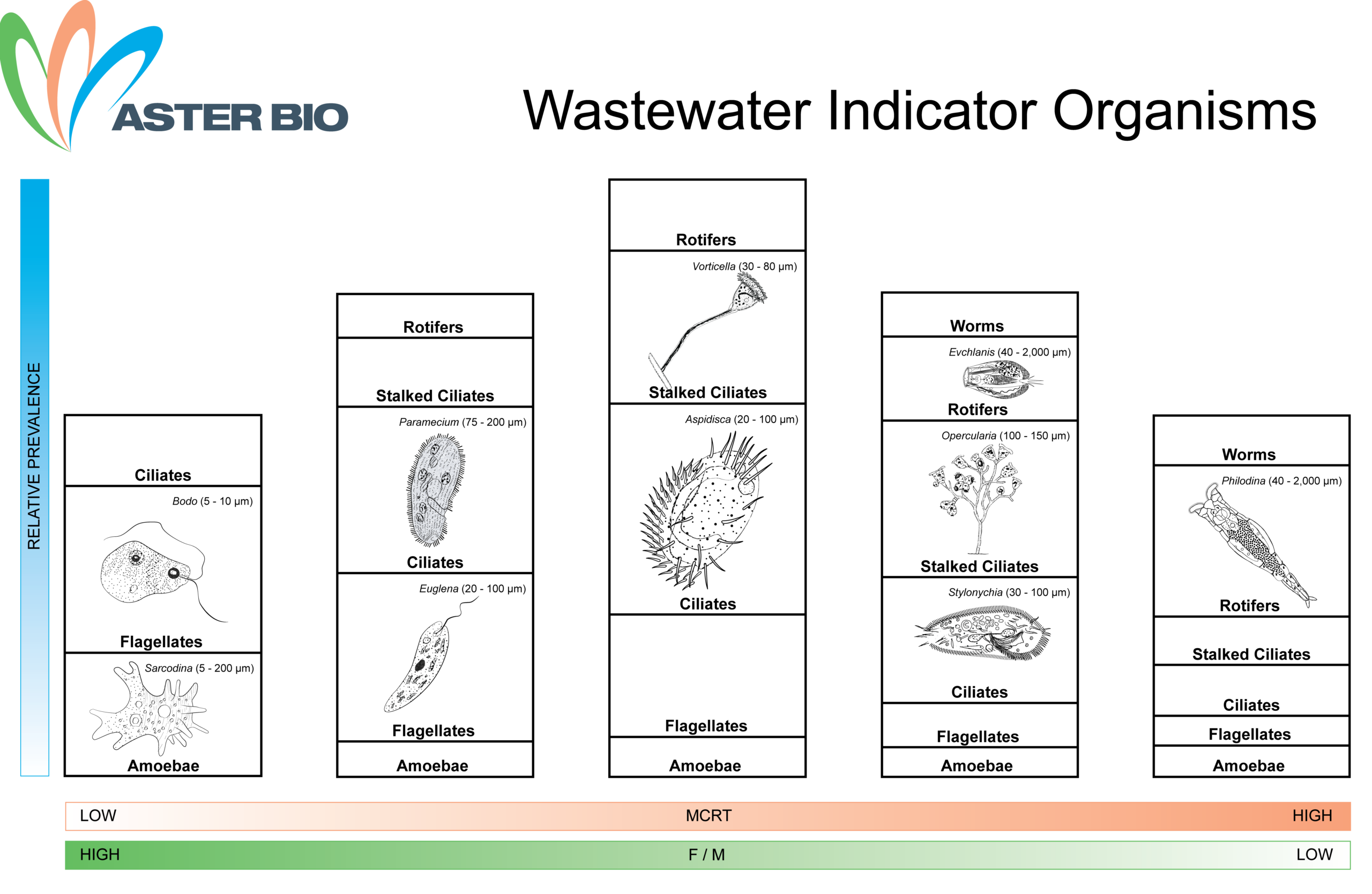
Protozoa and metazoa act as living performance indicators. Their presence, abundance, and behavior reflect how well the bacterial community—the true engine of treatment—is functioning.
Protozoa
Protozoa are typically the first eukaryotes you’ll see as a system matures. They thrive when soluble organics drop and floc becomes more structured.
- Amoebae — Early‑stage or stressed systems. Their dominance often signals high load, toxicity, or young sludge age.
- Flagellates — Transitional organisms. They appear as the system stabilizes but still has elevated soluble BOD.
- Ciliates — Indicators of a well‑balanced system. Free‑swimming ciliates suggest moderate loading; attached ciliates indicate strong floc formation and excellent settling.
Metazoa
Metazoa (rotifers, nematodes, tardigrades) appear only when the system is mature, stable, and low in toxicity.
- Rotifers — Hallmark of long sludge age and excellent nitrification.
- Nematodes — Common in older sludge; may increase when DO is low or solids are high.
- Tardigrades — Rare but meaningful. Their presence often indicates extremely stable biomass with robust floc.
What these organisms tell you about system conditions
Each group correlates with specific operational states:
- High amoebae + flagellates → Young sludge, high F/M, possible toxicity
- Dominant ciliates → Strong biological activity, good BOD removal, stable floc
- Rotifers + metazoa → Long sludge age, low toxicity, excellent nitrification
- Sudden disappearance of eukaryotes → Acute toxicity or major loading shift
These organisms don’t just appear randomly—they track directly with system performance.
Pairing eukaryotes with floc evaluation
Eukaryotic indicators are powerful, but they’re even more meaningful when combined with floc assessment.
Floc structure
Healthy floc is compact, irregular, and well‑bound with EPS. Poor floc is diffuse, fragile, or slimy.
- Compact floc + attached ciliates → Excellent settling and biological stability
- Diffuse floc + free‑swimming ciliates → System stabilizing but not fully mature
- Fragile floc + amoebae → High load or toxicity
Floc density
Dense floc settles quickly and supports attached organisms. Light floc indicates young sludge or insufficient EPS.
Filaments
Filaments provide macrostructure—but too many cause bulking.
- Low filament presence → Ideal structure and settling
- Moderate filaments → Normal macrostructure
- High filaments → Bulking, poor compaction, possible nutrient imbalance
Bringing it all together: a biological “dashboard”
Operators can treat protozoa, metazoa, and floc characteristics as a real‑time biological dashboard:
- Eukaryotes show who is thriving
- Floc structure shows how bacteria are organizing
- Filaments show what is holding the biomass together
- Density shows how well the sludge will settle
When these indicators align—ciliates + compact floc + moderate filaments—you’re looking at a system that’s biologically healthy, stable, and performing at its peak.
Key takeaway
Indicator protozoa and metazoa are not just interesting microscope finds—they’re essential operational tools. By pairing their presence with floc structure, density, and filament evaluation, operators gain a fast, reliable, and highly visual understanding of system health without waiting for lab results.