August 12, 2026 · Erik Rumbaugh
Shear, Select, Densify: The Biology Behind Better-Settling Sludge
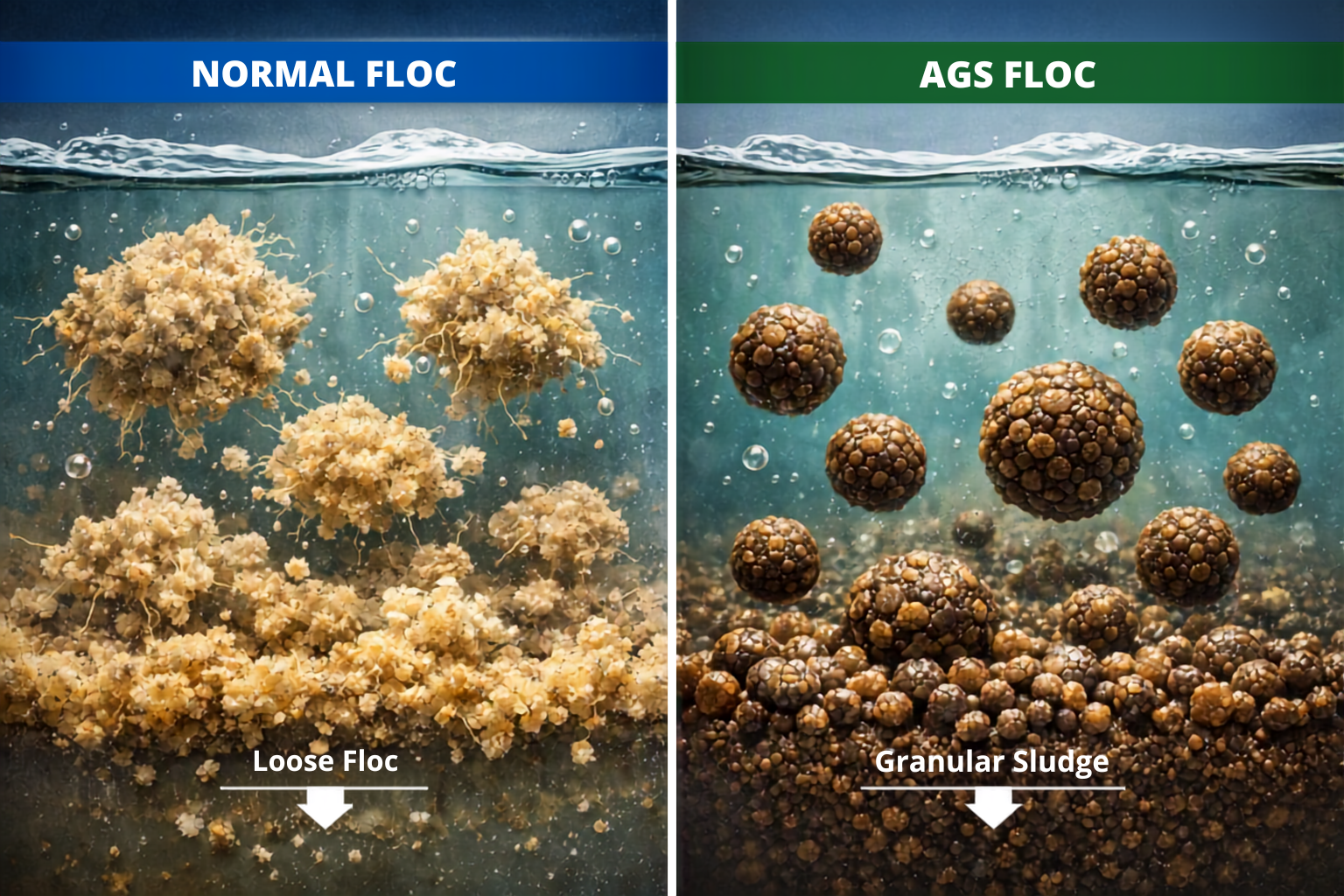
The Core Idea: Selection Pressure + EPS Remodeling
The densification and AGS processes share a simple but powerful ecological principle:
If you remove Loosely Bound (LB‑EPS) and retain only biomass with strong Tightly Bound (TB‑EPS), the system naturally shifts toward dense, compact floc or granules.
LB‑EPS behaves like a hydrated, fluffy outer layer. It traps water, increases sludge volume, and makes floc fragile. TB‑EPS, on the other hand, forms the structural backbone of dense floc and granules — cohesive, compact, and resistant to shear.
Densification & AGS technologies create controlled shear and settling selection that strip away LB‑EPS and push the microbial community toward organisms and EPS types that form tighter, denser structures.
Why LB‑EPS Is the Enemy of Dense Floc
LB‑EPS contributes to:
- High SVI and slow settling
- Fluffy, weak floc that breaks apart under stress
- Poor compaction in clarifiers
- Excess water in RAS and WAS streams
LB‑EPS is easily sheared off — and that’s exactly what densification and AGS systems exploit.
When LB‑EPS is removed, it goes out with waste sludge, leaving behind biomass with stronger TB‑EPS matrices. Over time, this selective removal shifts the entire population toward compact, dense floc.
Densification technologies (like selective wasting, controlled mixing, or intensified clarifier return strategies) use three main mechanisms:
1. Moderate Shear to Strip LB‑EPS
Mixing energy is tuned to shear off the hydrated outer layer of floc. This exposes the denser core and removes organisms that rely on LB‑EPS for structure.
2. Settling-Based Selection
Heavier, denser particles settle faster and are preferentially retained. Light, LB‑EPS‑rich floc is wasted.
3. Feast–Famine Cycling
Short feast periods followed by longer famine periods encourage TB‑EPS production and discourage organisms that rely on LB‑EPS.
The result: 200–400 µm compact floc, lower SVI, and improved clarifier performance.
Aerobic Granular Sludge: The Same Biology, Intensified
AGS systems take the same principles and amplify them:
1. Strong Feast–Famine Dynamics
Granules form when microbes store carbon during feast and strengthen EPS during famine. This favors TB‑EPS‑rich organisms like PAOs and GAOs.
2. High Shear in the Aeration Phase
Granules are constantly shaped by shear. LB‑EPS is removed, and only cohesive, dense aggregates survive.
3. Settling Selection in SBR Cycles
Fast-settling granules are retained. Slow-settling LB‑EPS floc is wasted every cycle.
4. Microbial Stratification
Granules develop aerobic outer layers and anoxic/anaerobic cores — a structure only possible when TB‑EPS dominates.
The outcome: spherical, dense granules with extremely low SVI (<60 mL/g) and excellent nutrient removal.
The Shared Mechanism: Shear → Waste → Densify
Both densification and AGS rely on the same ecological loop:
- Apply shear → LB‑EPS breaks off
- Waste the LB‑EPS-rich biomass → removes weak floc
- Retain dense, TB‑EPS-rich biomass → strengthens the population
- Repeat → the system becomes progressively more compact
This is microbial selection in action — not chemical conditioning, not mechanical thickening, but ecology-driven densification.
Why This Matters for Operators
Dense floc and granules deliver:
- Lower SVI and faster settling
- Higher clarifier capacity
- Better compaction and thicker RAS
- Improved nutrient removal
- More stable operation under load swings