August 20, 2026 · Erik Rumbaugh
Microbial Ecology Is the Operating Manual for Wastewater Treatment
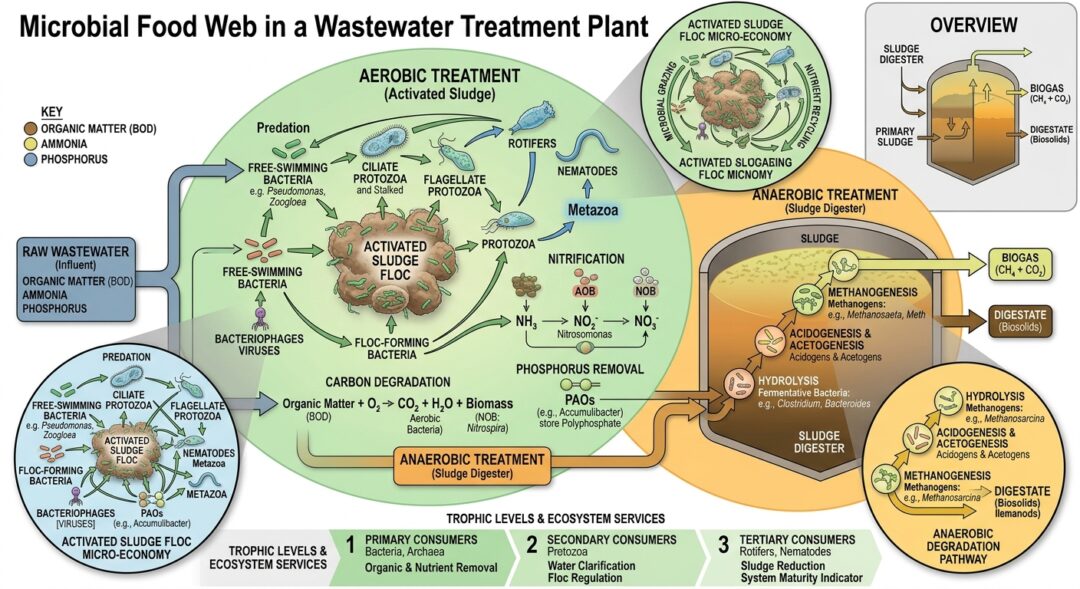
Microbial ecologyis not an academic layer addedto wastewater treatment and bioremediation —it istheoperating basis of the process. Settling, nitrification, denitrification, biological phosphorus removal, foam control, odor control, and effluent stability all depend on how the microbial community responds to the conditions we create in the system. When the ecology shifts, process performance shifts with it.
This article explains why microbial ecology must be part of routine process evaluation, how environmental pressures select for specific organisms, and why sound diagnosis must come before operational changes, chemical addition, or bioaugmentation.
Microbial Ecology: The Real Engine of Treatment
Activated sludge, fixed-film systems, lagoons, digesters, and bioremediation systems are all selective environments. Microorganisms grow, compete, flocculate, nitrify, denitrify, store phosphorus, generate foam, or wash out based on the pressures imposed by the process:
- Oxygen availability
- Carbon source type and concentration
- Nutrient ratios
- Temperature
- Sludge age
- Toxicity or inhibitory compounds
- Hydraulics and mixing
- Selectors, zones, and gradients
What we call microbial “behavior” is the community’s measurable response to those conditions. If we understand the pressures, we can anticipate which populations will be favored. If we understand the populations, we can make process changes with a biological basis instead of reacting to symptoms.
Why Ecology Matters More Than Symptoms
Operators and engineers often see symptoms first: high SVI, rising effluent ammonia, nitrite accumulation, foam, pin floc, poor compaction, or unstable phosphorus release and uptake. Those indicators matter, but they are usually late-stage signals. The microbial community has already responded to a stressor before the symptom appears in the clarifier, effluent, or lab data.
Microbial ecology gives you the cause , not just the effect.
Ecology-first thinking prevents:
- Treating symptoms instead of root causes
- Overusing chemicals or polymer
- Misdiagnosing filament problems
- Chasing ammonia with aeration when the real issue is toxicity
- “Fixing” EBPR with carbon when the real issue is PAO competition
- Applying bioaugmentation without understanding the stressor
The rule is simple: Never change or add anything until you understand the environmental pressure driving the biology.
How the Environment Shapes Biological Outcomes
1. Filamentous Bulking
Filaments don’t appear randomly. They thrive when the environment favors slow-growing, surface-attached organisms.
Common pressures:
- Low DO
- High F/M or low F/M (different filaments respond differently)
- Septicity
- Nutrient imbalance
- Insufficient selectors
- Excessive grease or long chain fatty acids
Using advanced microscopic exam and molecular testing can identify the filament and what is triggering their proliferation. With this information, you can take steps to control bulking pressures.
2. Ammonia or Nitrite Problems
Nitrifiers are sensitive, slow-growing organisms. When they decline, it’s almost always due to environmental stress.
Key pressures:
- Low DO
- Toxicity (industrial influent, cleaning agents, metals)
- Low alkalinity
- Temperature drops
- Short sludge age
If ammonia rises, the question isn’t “How do I remove ammonia?” It’s “What environmental pressure is suppressing nitrifiers?”
3. EBPR Phosphorus Removal Issues
Enhanced Biological Phosphorus Removal (EBPR) works only when PAOs outcompete GAOs and other organisms.
Pressures that destabilize EBPR:
- Carbon type (VFAs vs. sugars)
- Anaerobic zone strength
- Temperature
- pH
- Sludge age
- Excess nitrate carryover
- Competition from GAOs
4. Foaming
Foaming organisms (Nocardia, Microthrix, Gordonia) thrive under very specific conditions.
Environmental drivers:
- High FOG
- Long sludge age
- Hydrophobic substrates
How We Evaluate Microbial Ecology with Modern Tools
A useful microbial ecology assessment combines field observations, process data, and targeted biological testing. No single test explains the entire ecosystem. The best evaluations triangulate metabolic activity, organism structure, biomass viability, and community composition so the plant can separate loading issues from toxicity, solids age problems, nutrient imbalance, selector limitations, or population-level shifts.
Oxygen Uptake Rates (OUR and SOUR)
OUR is one of the fastest ways to measure real-time biological activity. By tracking how quickly mixed liquor consumes dissolved oxygen under controlled conditions, operators can see whether the biomass is actively oxidizing substrate, responding to a load increase, inhibited by toxicity, or operating near endogenous respiration. Specific Oxygen Uptake Rate (SOUR) normalizes that respiration to biomass concentration, which makes trending more meaningful across changes in MLSS or MLVSS. OUR testing is especially valuable for load tracking, toxicity screening, aeration validation, nitrification diagnostics, and evaluating whether bioaugmentation or nutrient-balancing strategies are changing biological activity.
Microscopic examination
Microscopy remains a high-value diagnostic tool because it shows floc structure, filament abundance, protozoan and metazoan indicators, dispersed growth, pin floc, zoogleal growth, and foam-forming morphology. It helps connect process symptoms to visible biomass condition. For example, a high SVI caused by open floc structure is not the same problem as high SVI caused by filamentous bridging, and a nitrification issue with healthy higher life forms points to a different investigation than one with dispersed, stressed biomass.
ATP testing
Adenosine triphosphate testing provides a rapid indicator of active biomass and biological stress. Total ATP and intracellular ATP can help distinguish viable biological inventory from inert solids, identify toxicity or inhibition, and evaluate recovery after an upset. When ATP trends are paired with OUR, operators can tell whether a change in respiration reflects more active biomass, a stronger food source, inhibition, or a loss of viable cells.
Molecular DNA testing
Molecular tools add a community-level view that traditional tests cannot provide. DNA-based testing can identify and track key functional groups such as ammonia-oxidizing bacteria, nitrite-oxidizing bacteria, denitrifiers, PAOs, GAOs, foam-formers, sulfur-related organisms, and filaments that are difficult to resolve by microscopy alone. Depending on the objective, molecular work may include targeted assays, sequencing, or broader community profiling. These results are most powerful when interpreted with process conditions, because the presence of an organism does not prove it is active; it shows the ecological potential present in the system.
Together, OUR, microscopy, ATP, and molecular testing move microbial ecology from guesswork to diagnosis. OUR tells us what the biomass is doing metabolically. Microscopy shows the physical and biological condition of the floc. ATP indicates how much viable biomass is present and how stressed it may be. Molecular testing reveals which organisms and functional groups are available to perform the work. When these tools tell the same story, process decisions become much more defensible.
Diagnosis Before Action
The most important operational principle:
You cannot fix a biological problem without understanding the biological pressure causing it.
This means:
- Don’t increase wasting until you know which organisms you’re removing.
- Don’t add air until you know whether DO is the limiting factor.
- Don’t add chemicals until you know whether the biology is capable of meeting the goal.
- Don’t add microbes until you know what stressor suppressed the native population.
Correct diagnosis = correct solution.
How to Think Like a Microbial Ecologist
A microbial ecology mindset asks three questions:
- What environmental pressure changed? (Load, flow, DO, toxicity, temperature, carbon type, sludge age)
- Which organisms responded to that change? (Filaments, nitrifiers, PAOs, GAOs, foam-formers, floc-formers)
- How did their response create the operational symptom? (Bulking, ammonia, nitrite, phosphorus instability, foaming)
Once you answer these, the solution becomes clear.
The Takeaway
Wastewater treatment and bioremediation are biological processes. The biology is the process. When you manage the environment, you manage the microbes. When you manage the microbes, you control the system.