September 16, 2026 · Erik Rumbaugh
From Microbial Data to Plant Performance: The Science Behind MCA Testing
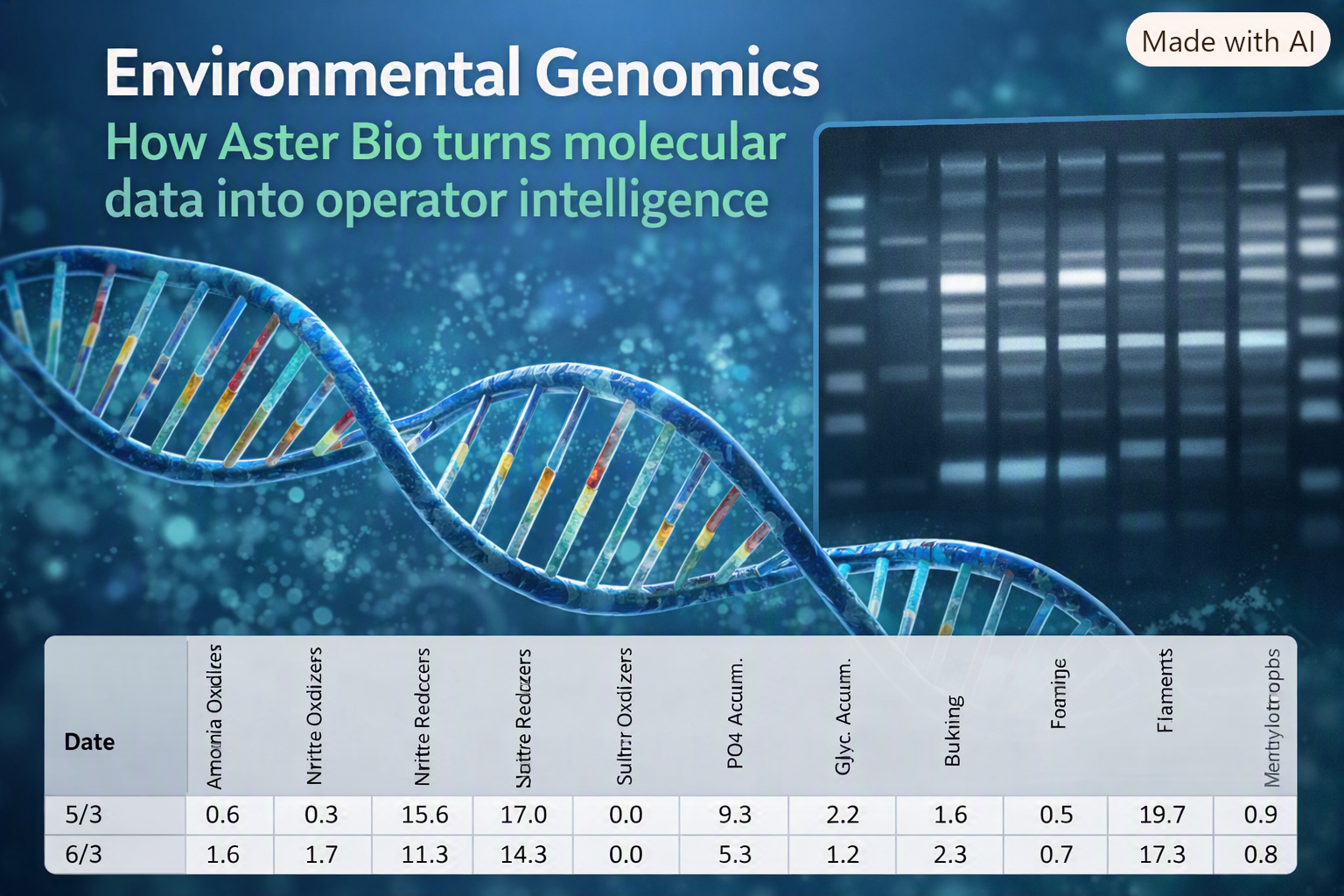
Aster Bio’s Environmental Genomics MCA test is built on a simple idea: wastewater treatment is driven by biology, so the best way to optimize a plant is to understand that biology at a molecular level. But behind that simple idea is a sophisticated workflow that combines sequencing technology, bioinformatics, and applied wastewater biology.
To better understand Environmental Genomics, it is good to look at the technology behind the results:
- 16S sequencing for bacteria and archaea
- Calling raw sequence data using curated databases and alignment tools
- Transforming complex molecular data into functional groups operators can use daily
16S Sequencing: The Backbone of Microbial Identification
Environmental Genomics begins with 16S rRNA gene sequencing, the gold‑standard method for identifying bacteria and archaea in complex environments like activated sludge.
Why 16S?
The 16S rRNA gene contains:
- Highly conserved regions — shared across all bacteria/archaea
- Hypervariable regions — unique signatures that differentiate microbial taxa
This combination allows sequencing instruments to read millions of fragments and determine which organisms are present and in what proportions.
How Aster Bio uses 16S sequencing
- Samples are collected from the biological unit
- DNA is extracted from the mixed liquor
- The 16S gene is amplified and sequenced using high‑throughput platforms
- Millions of reads are generated, each representing a microbial “barcode”
The result is a complete census of bacteria and archaea in the system — far beyond what microscopy alone can reveal.
Calling Raw Sequence Data: Databases, Alignment, and Quality Control
Sequencing produces raw reads — but raw reads are just noise until they’re interpreted. This is where bioinformatics comes in.
Step 1: Quality Filtering
Before any biological interpretation:
- Low‑quality reads are removed
- Chimeric sequences are filtered
- Adapter sequences are trimmed
This ensures only reliable data move forward.
Step 2: Alignment and Taxonomic Assignment
Aster Bio uses curated microbial databases and alignment algorithms to match each read to known organisms.
Key components include:
- Reference databases (curated for wastewater relevance)
- Alignment programs that compare reads to known sequences
- Taxonomic classifiers that assign each read from kingdom to more specific genus level ID
This step transforms millions of fragments into a structured list of organisms and their relative abundance.
Step 3: Data Normalization
Because sequencing depth varies, Aster Bio normalizes the data to ensure:
- Accurate comparisons between samples
- Reliable trend analysis
- Meaningful interpretation of microbial shifts
This is essential for operational decision making.
Making the Data Useful: Functional Groups for Wastewater Operations
This is the hardest part — and the part where Aster Bio’s MCA test stands apart.
Raw sequencing data produces a list of hundreds of organisms, many of which have no direct operational meaning. Operators don’t need a list of obscure genera. They need to know:
- Are my nitrifiers healthy?
- Are filaments increasing?
- Do I have enough FOG degraders?
- Is denitrification stable?
- Are PAOs present for phosphorus removal?
Functional Groups: The Operator‑Ready Solution
Aster Bio maps each organism to a functional group based on:
- Known metabolic pathways
- Wastewater‑specific literature
- Aster Bio’s proprietary microbial behavior database
Examples of functional groups:
- Nitrifiers (ammonia oxidation)
- Denitrifiers (total nitrogen removal)
- PAOs (biological phosphorus removal)
- Filaments (settling and bulking)
- FOG degraders (collection system and lift station health)
- EPS producers (floc structure and settling)
Why functional groups matter
Functional groups translate complex molecular data into:
- Operational flags
- Biological trends
- Actionable recommendations
- Early warning indicators
This is what makes Environmental Genomics practical, not just scientific.
The MCA Advantage
Aster Bio’s MCA test integrates:
- Sequencing
- Bioinformatics
- Functional group analytics
- Operational interpretation
The result is a biological snapshot that operators can use to:
- Improve settling
- Stabilize nitrification
- Reduce filaments
- Optimize nutrient removal
- Prevent upsets
- Reduce chemical costs
Environmental Genomics is powerful because it connects advanced molecular science with real‑world wastewater operations.
In summary, the MCA test:
- Uses cutting‑edge 16S sequencing
- Processes data through rigorous bioinformatics
- Converts raw data into functional groups
- Delivers insights operators can act on immediately
This is how Aster Bio transforms biology from a black box into a predictive, controllable part of plant performance. In short, we turn molecular data into operational intelligence.