June 25, 2026 · Erik Rumbaugh
Filamentous Bulking: The Hidden Aeration Energy Penalty in Wastewater Treatment
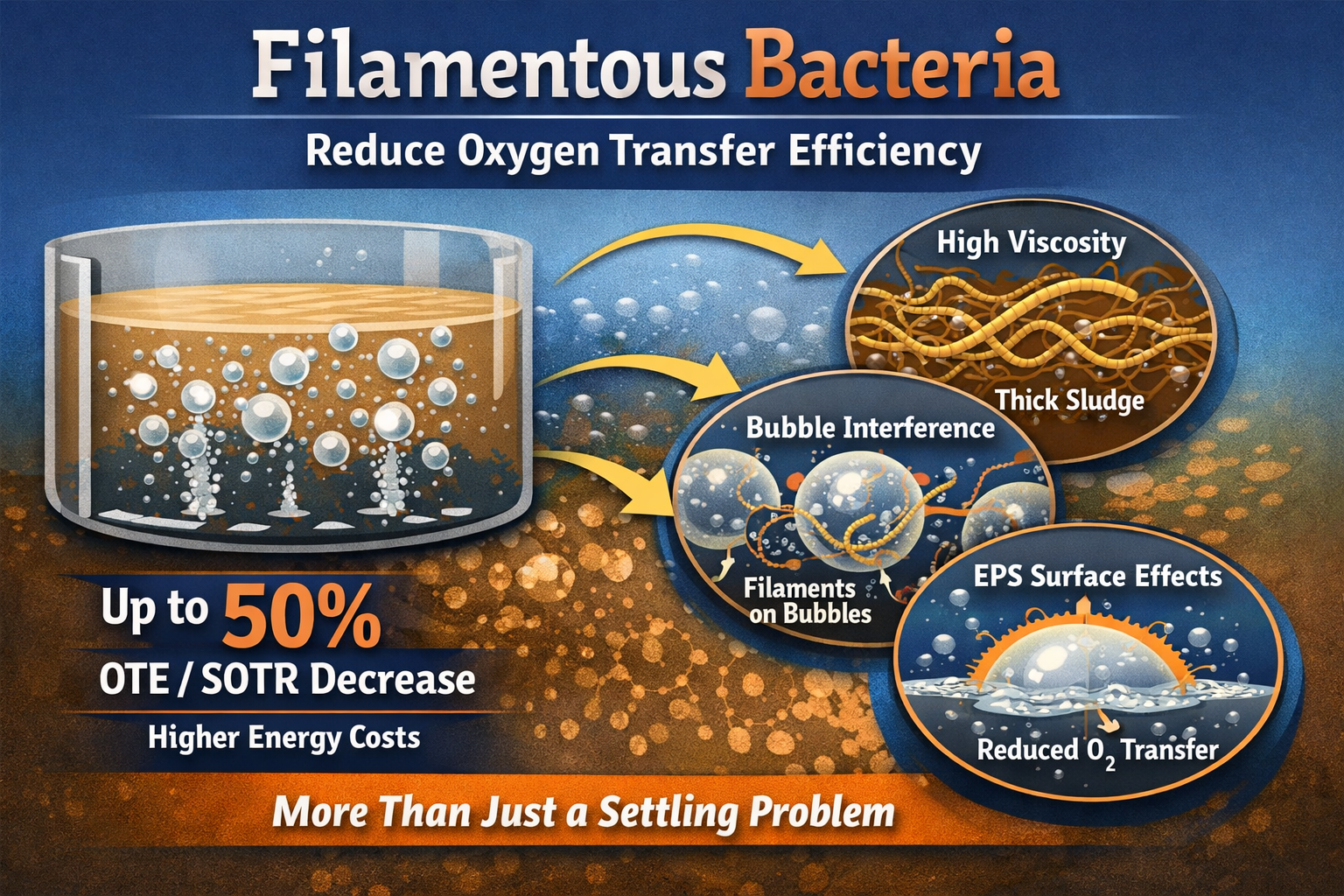
When talking about filamentous bacteria, the focus is usually on high SVI, poor settling, and clarifier washout risk. Those are real concerns—but they are only part of the story. Filaments can also reduce how effectively air becomes usable dissolved oxygen in the aeration basin.
That hidden oxygen transfer penalty can increase blower energy, narrow the DO control window, and destabilize biological performance—especially in systems already dealing with low DO, nutrient limitation, or seasonal filament pressure.
How Much Does OTE/SOTR Decrease?
Comparative research on floc-forming sludge (FFS) and filament-bulking sludge (FBS) shows a clear performance gap:
- Up to 50% reduction in OTE/SOTR when filaments dominate the biomass
- Longer filaments (e.g., Thiothrix) cause greater losses than short, intra-floc filaments
- Increased viscosity and EPS-rich surfaces amplify the decline
For plant staff, the impact can be thought of this way:
| Condition | Expected OTE/SOTR Impact |
|---|---|
| Normal floc-forming sludge | Baseline OTE |
| Moderate filament presence | 20–30% reduction |
| Severe filament bulking (e.g., Thiothrix) | Up to 50% reduction |
In practice, an aeration system that performs well under clean-water or healthy-sludge conditions may deliver far less oxygen when filamentous bulking changes the mixed liquor. A basin designed around 30% SOTE, for example, may operate closer to 10–15% OTE during severe filament pressure.
Why Filaments Reduce Oxygen Transfer
Filaments change the way mixed liquor behaves around bubbles. The main drivers are physical structure, bubble interaction, and surface chemistry.
1. Increased Mixed Liquor Viscosity
Filamentous sludge is often more viscous because the filaments form a network-like structure that resists flow.
Higher viscosity leads to:
- Reduced bubble rise velocity
- Lower turbulence around bubbles
- Decreased renewal of the gas–liquid interface
The result is a lower liquid-side mass transfer coefficient (kₗ)—one of the key drivers of oxygen transfer. In plain terms, the bubbles may still be there, but oxygen moves into the water less efficiently.
2. Filaments Attach to Bubble Surfaces
Long filaments such as Thiothrix can extend outside the floc and physically interact with rising air bubbles.
This causes:
- Distorted bubble shape
- Reduced effective interfacial area
- A “dragging” effect that slows bubble rise
- A partial barrier between air and water
The practical effect is less efficient contact between air and water. Even if the diffuser system is operating normally, bubble–filament interaction can reduce the oxygen actually transferred into the process.
3. EPS and Surface Chemistry Effects (Surfactant-Like Behavior)
Many filamentous organisms produce extracellular polymeric substances (EPS). These materials can behave somewhat like surfactants at the gas–liquid interface.
EPS can:
- Form a stagnant film on bubble surfaces
- Reduce interfacial turbulence
- Lower kₗ even when bubble size decreases
- Increase gas holdup without improving transfer
This helps explain why OTE can fall even when airflow, diffuser condition, and basin operation appear normal. The limitation is not always the equipment—it can be the biology changing the interface where oxygen transfer occurs.
Why This Matters for Operators
For operators, the most important point is that filamentous bulking is not only a solids-separation issue. It is also an aeration efficiency issue.
When OTE drops:
- Blowers ramp up to maintain DO
- Energy consumption increases
- DO control becomes unstable
- Nitrification may suffer
- Low DO further promotes filament growth (a feedback loop)
In lagoons, oxidation ditches, and diffused-aeration basins, that can translate into significant monthly energy waste—especially when operators respond to low DO by simply increasing blower output.
The operational response should not stop at adding more air. If filaments are reducing transfer efficiency, the better long-term strategy is to identify the filament driver—such as low DO zones, nutrient imbalance, septicity, grease, sulfides, or sludge age conditions—and correct the underlying cause.
Key Takeaways
- Filamentous bacteria can reduce OTE/SOTR by up to 50%.
- Mechanisms include viscosity increase, bubble interference, and EPS-driven interfacial suppression.
- Filaments impact aeration efficiency, not just settling.
- Addressing filament growth improves both clarifier performance and energy efficiency.