June 11, 2026 · Erik Rumbaugh
Bioprospecting for Better Biology: How Aster Bio Discovers Wastewater Treatment Organisms
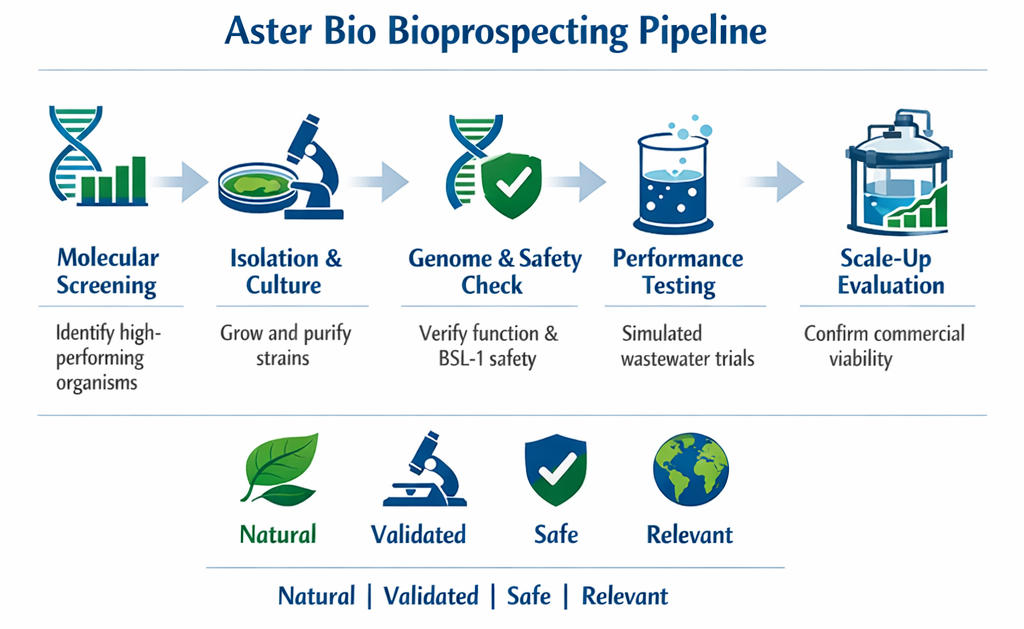
Wastewater treatment plants are living ecosystems. When they run well, it’s because the right microbial communities are present, balanced, and active. At Aster Bio, our R&D team studies these ecosystems to identify naturally occurring organisms that can help operators solve persistent challenges — from bulking and foaming to nutrient removal and degradation of hard‑to‑treat organics.
This discovery process is called bioprospecting, and it’s one of the most important parts of how we develop next‑generation bioaugmentation products. Unlike generic “bugs in a jug,” our strains originate from real, high‑performing wastewater systems and undergo rigorous scientific evaluation before they ever reach a plant.
Below is an inside look at how our bioprospecting pipeline works.
Identifying promising organisms using molecular testing
Healthy wastewater systems contain microbial signatures that correlate with stability, low sludge volume, strong nutrient removal, and efficient organic degradation. Using Environmental Genomics — our molecular testing platform — we analyze these communities at high resolution.
We look for:
- Organisms enriched in stable, well‑performing systems
- Populations associated with specific treatment functions (e.g., nitrification, PAO activity, foam suppression)
- Rare or under‑characterized microbes that appear consistently in high‑quality biomass
This step gives us a data‑driven shortlist of candidate organisms worth isolating.
Isolating and culturing target organisms
Once candidates are identified, our microbiologists use traditional culturing techniques to isolate them from mixed liquor samples.
This includes:
- Selective media
- Enrichment cultures
- Microscopy‑guided colony selection
- Repeated purification to ensure monocultures
Culturing wastewater organisms is notoriously difficult — many are slow‑growing or require specific environmental conditions. Our team has developed specialized methods to coax these organisms into stable laboratory cultures.
Full genome sequencing and biosafety verification
Every isolate undergoes whole‑genome sequencing to confirm identity and ensure it meets BSL‑1 safety requirements.
Sequencing allows us to:
- Verify taxonomy
- Screen for unwanted traits
- Confirm metabolic pathways of interest
- Ensure regulatory compliance for commercial use
This step is non‑negotiable — only strains that meet strict safety and functional criteria move forward.
Testing performance in simulated wastewater environments
Next, we evaluate each organism’s real‑world potential through controlled testing.
We assess:
- Degradation of target compounds (e.g., FOG, surfactants, recalcitrant organics)
- Impact on sludge settleability
- Influence on foam‑forming populations
- Contribution to nutrient removal pathways
- Stability under variable loading or environmental stress
These tests help us understand not just what the organism can do, but how it behaves in a dynamic wastewater ecosystem.
Determining suitability for large‑scale cultivation
The final step is evaluating whether the organism can be produced reliably at commercial scale.
We examine:
- Growth kinetics
- Nutrient requirements
- Oxygen demand
- Shelf stability
- Compatibility with existing product formulations
Only strains that demonstrate strong performance, predictable growth, and long‑term stability become part of Aster Bio’s bioaugmentation portfolio.
Why this process matters
Bioprospecting ensures that every organism we use is:
- Naturally occurring
- Scientifically validated
- Safe for operators and the environment
- Functionally relevant to real wastewater challenges
It’s a level of rigor that sets Aster Bio apart — and it’s why our products consistently deliver measurable improvements in plant performance.