
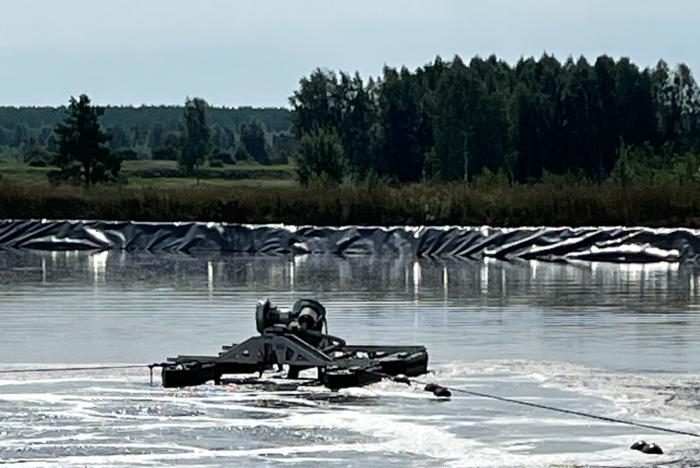
Hog farm manure treatment lagoon
Executive Summary
Aster Bio developed AB 40, a next‑generation microbial blend engineered specifically for high‑density animal feeding operations (CAFOs). Unlike commodity biological products grown for ease of fermentation, AB 40 was built from the ground up using metabolic pathway analysis, environmental genomics, and multi‑site field trials.
Across controlled studies and commercial deployments, AB 40 demonstrated the ability to:
- Reduce in‑house ammonia concentrations
- Lower odor emissions from barns and lagoons
- Liquefy pull‑pit and pit‑bottom solids for easier flushing
- Accelerate sludge destruction in lagoons
- Improve soil structure and grass growth when used in land‑applied effluent
These outcomes show that targeted microbial ecology can reduce operational burdens while improving environmental performance.
- Introduction
High‑density animal feeding operations face persistent challenges related to ammonia emissions, odor generation, and accumulated solids in pits and lagoons. Traditional approaches—chemical additives, mechanical agitation, or periodic dredging—are costly, disruptive, and often fail to address the underlying biological imbalance.
Aster Bio’s research team pursued a different strategy: designing a microbial consortium optimized for the metabolic conditions of manure systems, rather than relying on organisms that are simply easy to grow in a fermenter. This white paper outlines the scientific approach, trial methodology, and performance outcomes that led to the development of AB 40.
-
Scientific Framework for Microbial Selection
Aster Bio’s R&D program began with a fundamental question: Which microbial pathways are most beneficial for manure stabilization and solids destruction?
2.1 Metabolic Pathway Targeting
Using environmental genomics and metabolic profiling, researchers identified key pathways associated with:
- Urease and ammonia‑reducing metabolism
- Volatile fatty acid (VFA) degradation
- Cellulolytic and hemicellulolytic breakdown of fibrous solids
- FOG (fats, oils, grease) hydrolysis
- Anaerobic and facultative respiration suited to pit and lagoon conditions
Organisms were selected based on functional performance, not ease of cultivation.
2.2 Strain Stabilization and Formulation
To ensure field reliability, Aster Bio developed a shelf‑stable dry formulation with:
- Containing both spore forming and vegetative organisms
- Rapid activation upon hydration
- Resistance to temperature swings common in barns and lagoons
- Cost‑effective production without compromising strain diversity
This formulation became the foundation of AB 40.
-
Research Design and Field Trials
Aster Bio conducted multi‑site, multi‑season trials across swine, poultry, and cattle operations. Each trial included:
- Baseline sampling of ammonia, odor intensity, sludge depth, and solids composition
- Routine application of AB 40 to manure pits and pull-pits
- Weekly to monthly monitoring of biological and operational metrics
- Statistical analysis of performance trends
3.1 Data Collection Methods
- Ammonia monitoring using in‑house sensors and handheld analyzers
- Odor scoring using standardized olfactometry scales
- Sludge depth surveys using core samplers and sonar probes
- Solids characterization via moisture, fiber, and VFA analysis
- Soil and vegetation assessments for land‑applied effluent
These methods ensured reproducible, operator‑relevant data.
-
Key Findings
4.1 Reduction in Ammonia and Odors
Across all trial sites, AB 40 produced measurable reductions in in‑house ammonia and barn odors.
- Ammonia reductions were typically observed within 7–14 days. In-house ammonia decreased 29.9% in hog operations.
- Odor intensity decreased as VFAs and sulfur compounds were biologically degraded. Atmospheric VOCs decreased by 55.6%. Odor power reduction measured by organoleptic testing found an 88% improvement.
- Operators reported improved working conditions and animal comfort.
4.2 Liquefaction of Pull‑Pit and Pit‑Bottom Solids
AB 40 accelerated the breakdown of fibrous and organic solids, resulting in:
- Liquefied pull‑pit solids that flushed easily to lagoons
- Reduced need for mechanical agitation
- Lower risk of pipe blockages and pump strain
4.3 Lagoon Sludge Reduction
Benefits as bacteria dosed in house continued to function in treatment lagoons:
- Significant decreases in sludge depth
- Higher solids destruction rates compared to untreated lagoons
- Improved lagoon hydraulics and reduced dredging frequency
4.4 Environmental Impact Reduction
By improving biological stability, AB 40 helped operations:
- Reduce odor drift to surrounding communities
- Lower ammonia emissions, supporting air‑quality goals
- Improve effluent quality for land application
4.5 Soil and Vegetation Benefits
In fields receiving treated effluent:
- Grasses used for hay production showed improved growth
- Soil exhibited better structure and conditioning
- Root development increased due to beneficial rhizosphere organisms introduced via effluent
These side benefits highlight AB 40’s broader ecological value.
-
Why AB 40 Performs Better Than Commodity Microbial Products
Most biological additives rely on organisms that form spores and are easy to grow, not organisms that are functionally optimized for manure systems. AB 40 differs in several ways:
- Targeted metabolic pathways with both spore forming and vegetative organisms, not generic Bacillus blends
- Strain diversity tailored to anaerobic and facultative environments
- Field‑validated performance across multiple animal sectors
- Ease of application with no special equipment required
This combination of scientific rigor and practical usability sets AB 40 apart.
-
Conclusion
Aster Bio’s development of AB 40 demonstrates how applied microbial science can transform manure management in high‑density animal operations. By focusing on metabolic function, environmental compatibility, and real‑world performance, AB 40 delivers:
- Lower ammonia
- Reduced odors
- Liquefied solids
- Faster lagoon sludge destruction
- Improved soil and vegetation outcomes
The result is a cost‑effective, environmentally responsible, and operator‑friendly solution that elevates biological performance across the entire manure handling system.