
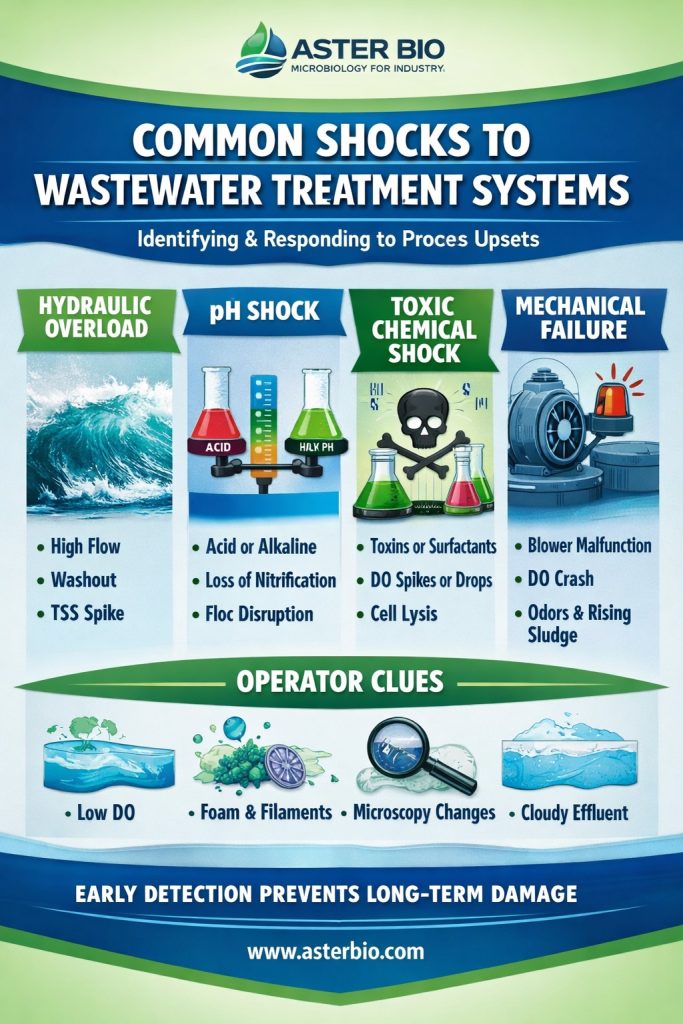
Even well‑run wastewater treatment systems face sudden, destabilizing events known as process shocks. These shocks disrupt biological activity, upset clarifiers, and threaten permit compliance — often with little warning. While every plant is unique, most upsets fall into four major categories:
- Hydraulic overloads
- pH shocks
- Toxic or quasi‑toxic chemical shocks
- Mechanical failures leading to DO collapse
Below is a clear breakdown of how each shock occurs, what it does to the biology, and the operator clues that help you diagnose the problem fast.
Hydraulic Overload (Flow Shock)
Hydraulic shocks occur when flow increases faster than the system can absorb, often due to storms, pump failures, EQ bypasses, or industrial discharges.
Why it destabilizes the system
- Reduces aeration contact time, lowering oxygen transfer
- Washes out MLSS, increasing F/M ratio
- Causes short‑circuiting in aeration and clarifiers
- Pushes solids into the effluent before they can settle
Operator clues
- DO drops in the front of the aeration basin
- Clarifier blankets lift or wash out
- Effluent TSS and turbidity spike
- RAS becomes dilute
Why it matters
Hydraulic overloads don’t just dilute — they disrupt the physical structure of the process, often triggering filament growth, nitrification loss, and settling problems for days afterward.
pH Shock
A sudden swing in pH — acidic or alkaline — can stun or kill key microbial groups.
Why it destabilizes the system
- Nitrifiers are extremely sensitive; activity collapses outside 6.5–8.5
- Acidic shocks lyse floc and release intracellular material
- Alkaline shocks inhibit enzyme systems and slow metabolism
- Rapid pH shifts destabilize EPS, causing deflocculation
Operator clues
- Sudden loss of nitrification
- Floc becomes “fluffy” or dispersed
- Microscopy shows lysed cells or weak EPS
- Foaming increases due to stressed biomass
Why it matters
pH shocks often cause multi‑day recovery periods, especially if nitrifiers are damaged. Even short exposures can create long‑lasting settling issues.
Toxic or Quasi‑Toxic Chemical Shock
These shocks occur when a harmful compound enters the system — solvents, surfactants, disinfectants, cyanide, metals, or industrial cleaners.
Why it destabilizes the system
- Toxicants inhibit respiration, causing DO to rise or fall abnormally
- Surfactants reduce α‑factor, cutting oxygen transfer efficiency
- Nitrifiers are the first to die off
- Some compounds cause cell lysis, releasing soluble COD
Operator clues
- DO behaves strangely: either spikes (biomass stunned) or crashes (oxygen transfer inhibited)
- Rapid nitrification loss
- Microscopy shows “ghost cells,” pin floc, or filament shifts
- Foaming or scum from surfactant loads
Why it matters
Chemical shocks can be subtle — the system may look normal until ammonia or TSS rises. Identifying the source quickly is critical to prevent long‑term biological damage.
Mechanical Failure Shock (Blower, Mixer, or Aeration Failure)
Mechanical failures are one of the fastest ways to trigger a biological emergency.
Why it destabilizes the system
- Loss of aeration causes instant DO collapse
- Low DO favors filaments like M. parvicella, Nocardia, and Thiothrix
- Mixing loss creates dead zones and localized septic conditions
- Nitrification stops almost immediately
Operator clues
- DO drops to zero in minutes
- Surface mixing disappears; basins look “flat”
- Strong odors from anaerobic pockets
- Clarifiers show rising sludge or denitrification gas
Why it matters
Mechanical shocks are often the most acute — a blower belt, VFD, or header blockage can turn a stable system into a crisis in under an hour.
Takeaway for Operators
System shocks are inevitable, but rapid recognition is the difference between a minor upset and a full‑scale process failure. Each shock type leaves a distinct fingerprint — in DO behavior, clarifier performance, microscopy, and effluent quality. Building operator awareness around these patterns helps stabilize the system faster and prevents long‑term damage to the biomass.