
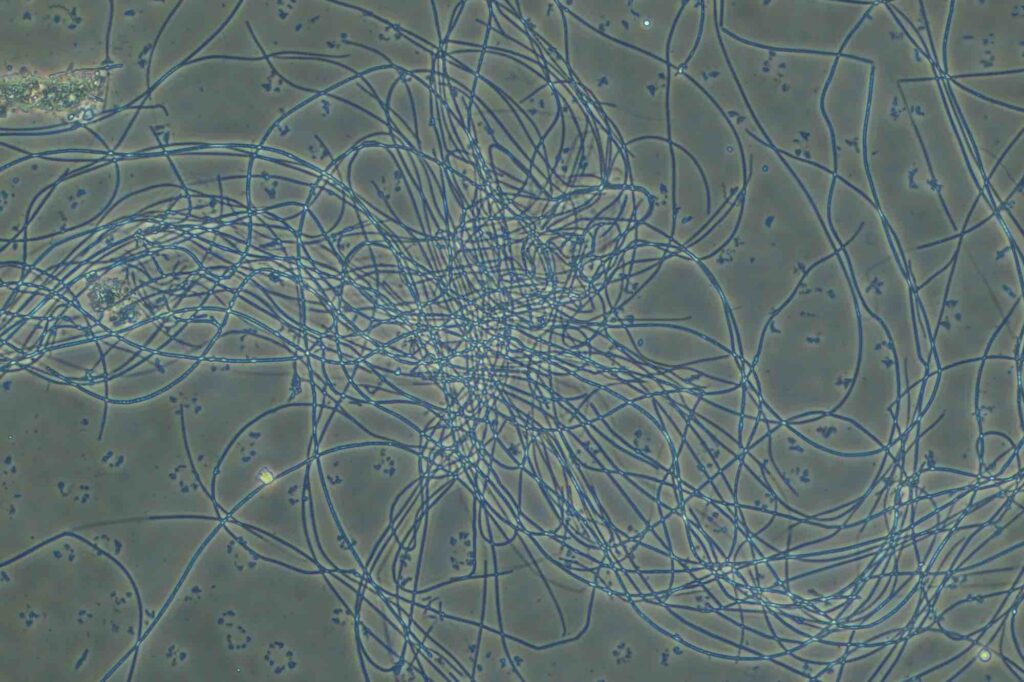
Severe case of filamentous bulking 400x phase contrast
Filamentous bulking is one of those problems every wastewater operator encounters eventually. You spot the tell‑tale signs—poor settling, rising sludge blankets, cloudy effluent—and the microscope confirms it: a filament is driving the issue.
But identifying the organism is only step one. The real question operators need answered is:
Why is this filament thriving, and what operational levers will bring the system back into balance?
That’s where Aster Bio’s MCA test and Environmental Genomics™ platform allow operators to ID the source of filaments and create control options.
Filament ID Is the Beginning, Not the End
Advanced microscopy gives you a snapshot of who is present. It’s essential—but it doesn’t explain:
- Whether the filament is responding to one or many factors including: low DO, high F/M, septicity, or nutrient imbalance
- Whether the filament is dominant or just visible
- Whether other organisms in the biomass are supporting or counteracting the bulking conditions
- Whether operational changes are helping or hurting the biology
Operators often end up guessing, adjusting multiple variables at once, or waiting days to see if a change worked.
Aster Bio’s MCA test eliminates some of that guesswork.
MCA Reveals the Biological Drivers Behind Bulking
Once the filament is identified, MCA provides a full biological profile of your biomass, including:
- Relative abundance of the filament (not just presence/absence)
- Functional pathways tied to bulking conditions (lipid degradation, sulfur cycling, denitrification, etc.)
- Population balance between floc formers, nitrifiers, PAOs, GAOs, and foam‑forming filaments
- Stress indicators showing toxicity, shock loading, or nutrient limitations
- Trend data showing whether the filament is increasing or decreasing
This turns a simple ID into a diagnostic map of what’s driving the problem.
Connecting Filament Behavior to Operational Causes
Every filament has a preferred ecological niche. MCA helps pinpoint which niche your system is accidentally creating.
For example:
- M. parvicella → favors long-chain fatty acids, low DO, and cold temperatures
- Gordonia/Nocardia → thrives on FOG
- Type 021N → linked to septicity and low nutrient ratios
- H. hydrossis → grows under low F/M and high sludge age
Aster Bio translates these biological signals into clear operational causes, such as:
- Insufficient aeration in specific zones
- High grease loading from upstream sources
- Carbon-to-nutrient imbalance
- Over-oxidation or under-oxidation of the biomass
- Return sludge conditions promoting filament growth
This is where operators finally get the “why” behind the bulking.
Turning Insight Into Action: Practical Control Strategies
Once the cause is known, Aster Bio works with operators to choose the best-fit control strategy, such as:
- Adjusting DO setpoints or aeration distribution
- Modifying RAS/WAS rates to shift sludge age
- Correcting nutrient ratios (N/P supplementation)
- Reducing septicity in the collection system or primary clarifier
- Managing FOG loading with upstream interventions
- Using targeted bioaugmentation to rebalance the microbial community
Because MCA tracks the biomass over time, operators can see:
- Whether the filament is declining
- Whether floc formers are recovering
- Whether nitrifiers or PAOs are being impacted
- Whether operational changes are producing the intended biological response
This is real feedback, not trial-and-error.
Why Operators Trust MCA for Bulking Control
Aster Bio’s approach gives operators:
- Clarity — no more guessing which filament is the real problem
- Confidence — decisions backed by biological data, not assumptions
- Speed — early detection before bulking becomes a crisis
- Control — the ability to tune the system based on how the biology responds
Filament ID tells you what is happening.
MCA tells you why—and what to do next.