July 7, 2026 · Erik Rumbaugh
Can Biosurfactants Make Heavy Metal Remediation Cleaner and Smarter?
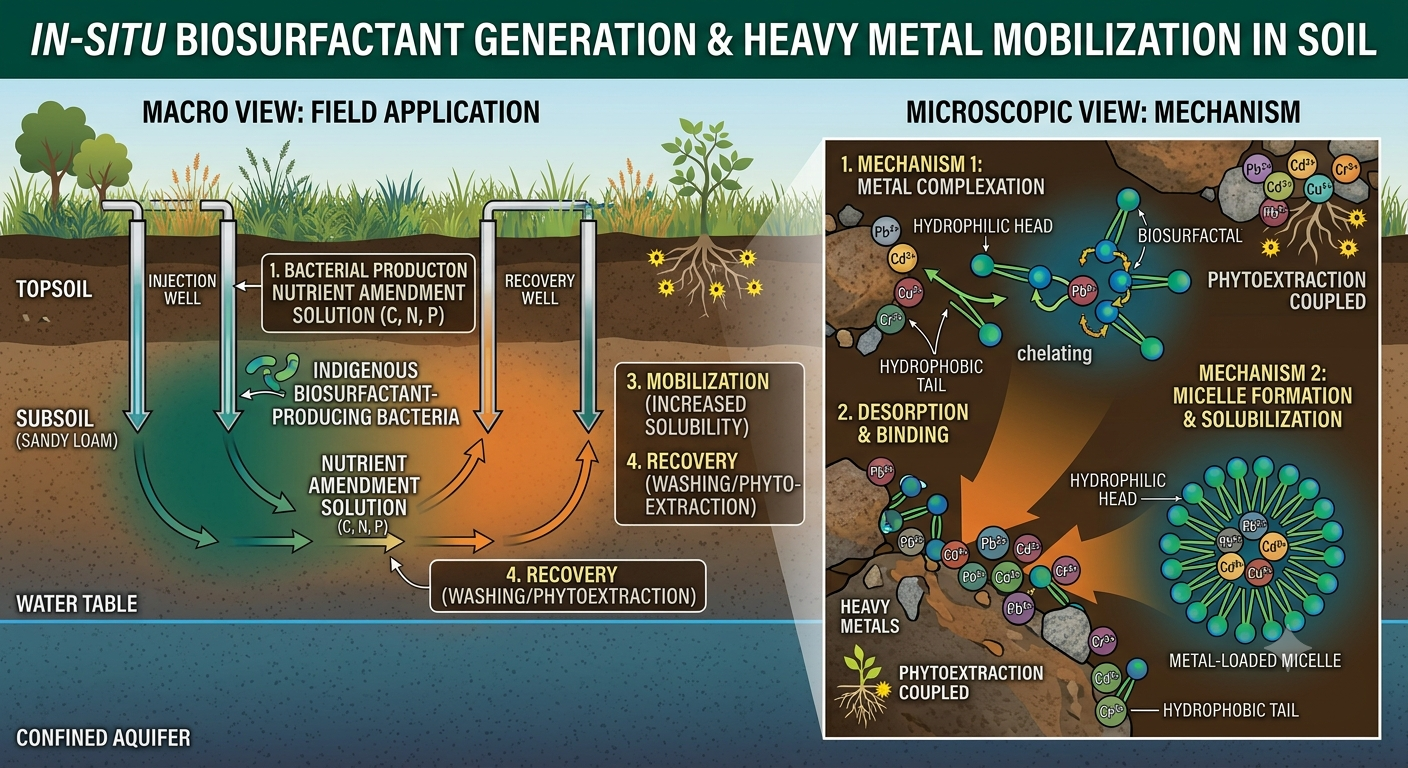
In-situ biosurfactant generation offers a compelling way to clean heavy-metal-contaminated soils without excavating them or relying on harsh chemical washes. The idea is simple: encourage microorganisms already present in the soil, or introduce carefully selected strains, to produce natural surface-active compounds that help mobilize metals for removal. For Aster Bio, the opportunity is promising—but practical success depends on matching the biology to the site’s soil chemistry, contamination profile, and hydrology.
This post explains how the approach works, where it can outperform conventional remediation, what still limits field deployment, and which engineering strategies can make it more practical at contaminated sites.
The Mechanism: How It Works
Traditional heavy metal remediation often requires digging up the soil (ex-situ) or injecting harsh synthetic chemicals. In-situ biosurfactant generation uses indigenous or introduced soil microorganisms (like Pseudomonas sp. or Bacillus sp.) to produce surface-active agents right in the ground.
These biosurfactants (such as rhamnolipids or lipopeptides) remove heavy metals via two primary mechanisms:
- Complexation/Chelation: The hydrophilic (water-loving) head of the biosurfactant binds with the heavy metal cations (
,
,
, etc.) through ionic or covalent bonding.
- Micelle Formation: Once the biosurfactants reach a specific concentration (Critical Micelle Concentration, or CMC), they form spheres called micelles. These micelles encapsulate the metal complexes, separating them from the soil particles and allowing them to be washed out via groundwater extraction or phytoremediation (plant uptake).
Feasibility Matrix: Pros vs. Cons
The Advantages (Why it ’s highly feasible)
- Environmental Sustainability: Biosurfactants are biodegradable, have low toxicity, and don’t leave secondary pollutants behind, unlike synthetic alternatives like EDTA.
- Cost-Effectiveness: Generating them in-situ eliminates the massive costs of ex-situ bioreactor production, purification, transport, and soil excavation.
- Dual Remediation: If the soil is co-contaminated with organic pollutants (like hydrocarbons) and heavy metals, the biosurfactants can mobilize the organics for biodegradation while chelating the metals.
The Bottlenecks (The Reality Check)
- Soil Matrix Complexity: Heavy metals are often tightly bound to soil organic matter, clays, and oxides. Biosurfactants must compete with these strong natural bonds.
- Microbial Survival: Soil is a harsh environment. High concentrations of heavy metals are inherently toxic to the very bacteria meant to produce the biosurfactants.
- Permeability Issues: In tight, clay-heavy soils, moving the nutrients in and flushing the mobilized metal-micelles out is incredibly difficult. It works best in sandy or loamy soils.
- Risk of Groundwater Contamination: Because you are mobilizing heavy metals into a liquid phase, there is a strict risk of those metals leaching downward into local aquifers if the hydrological control isn’t tightly managed.
Technical Enhancements to Boost Feasibility
To transition this technology from laboratory success to field feasibility, engineers generally use a few key strategies:
- Initial Biosurfactant Addition: Biosurfactants produces ex-situ can be used to initiate the metal mobilization. This coupled with bioaugmentation using known biosurfactant producing organisms can improve likelihood of success.
- Electrokinetic Remediation (EK): Pairing in-situ generation with low-voltage electric currents helps drive the biosurfactants and mobilized metals through low-permeability (clay) soils toward collection wells.
- Phytoremediation Coupling: Using plants alongside bacteria works beautifully. The bacteria mobilize the metals, and the plant roots suck them up (phytoextraction), preventing the metals from leaking into the groundwater.
The Verdict
Is it feasible? Yes, but with caveats.
In-situ biosurfactant generation is highly feasible for sandy or loamy soils with low-to-moderate, shallow contamination, especially when coupled with phytoremediation.
However, for highly compacted clay soils or areas with deep, extreme toxic shocks, the technology is currently less feasible as a standalone solution and requires heavy engineering intervention (like EK coupling) to be effective.
Site conditions ultimately determine the best remediation strategy. Soil texture, groundwater movement, contaminant depth, and the specific metal involved all influence which microbial strains, nutrients, and collection methods are likely to succeed.