
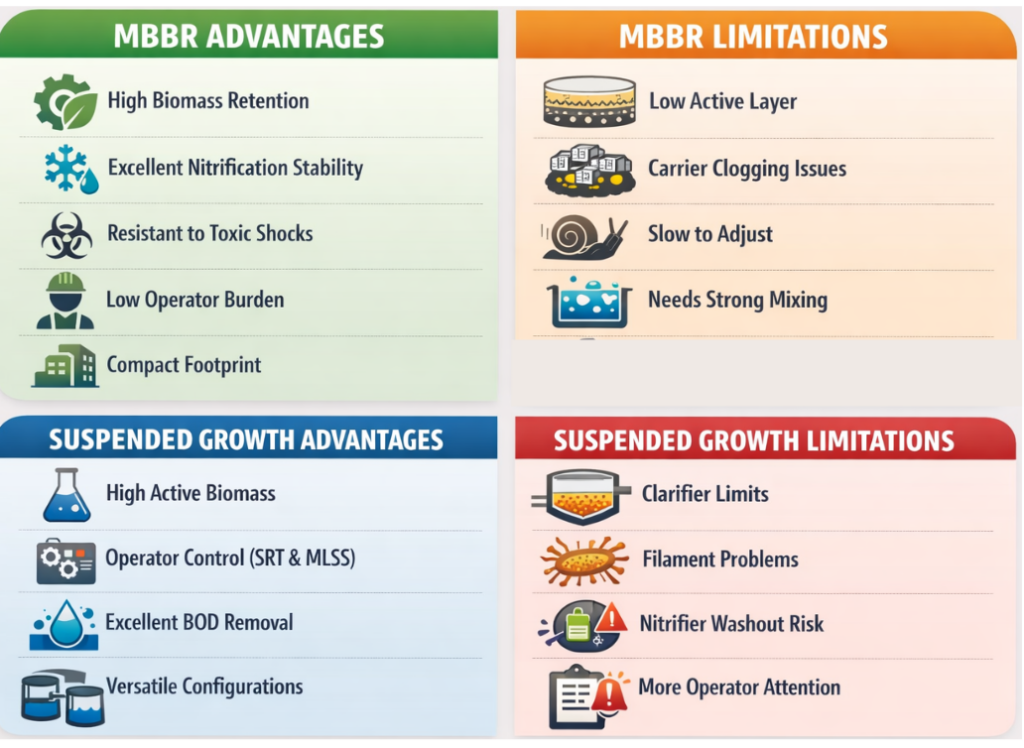
A clear difference between MBBR (attached‑growth) and suspended‑growth activated sludge is how much living biomass each system can maintain—and how that living fraction behaves under real operating conditions. The contrast shapes treatment capacity, stability, and operator strategy.
How Biomass Is Distributed in Each System
Attached Growth (MBBR)
MBBR carriers provide protected surface area where microbes form biofilms. These biofilms contain:
- A dense layer of actively respiring microbes closest to the wastewater.
- Deeper layers with slower‑growing or dormant organisms.
- EPS and inorganic material embedded in the matrix.
Because biofilms are physically retained on carriers, the system can maintain very high total biomass concentrations without depending on clarifiers or wasting rates. However, only the outer biofilm layer is highly active at any moment; deeper layers contribute resilience more than instantaneous treatment capacity.
Suspended Growth (Activated Sludge)
In suspended growth, biomass is dispersed as flocs in the aeration basin. The living fraction of MLVSS includes:
- Actively growing heterotrophs and nitrifiers.
- Dormant or decaying cells.
- EPS and adsorbed organics/inorganics.
Operators control biomass levels through SRT and wasting, which directly determine how much active biomass is present. Unlike MBBR, the system cannot accumulate unlimited biomass—MLSS must stay within clarifier settling limits.
How Much Living Biomass Is Actually Available?
Key Differences
| Feature | MBBR (Attached Growth) | Suspended Growth |
| Biomass retention | Very high; biofilm stays on carriers | Limited by clarifier settling & MLSS |
| Living vs. total biomass | High total biomass, but only outer layer is highly active | Lower total biomass, but a larger fraction is metabolically active |
| Nitrifier retention | Excellent—biofilms protect slow growers | Requires long SRT; nitrifiers easily washed out |
| Response to load swings | High resilience due to biomass depth | High responsiveness due to active floc fraction |
The Living Fraction
- MBBR: The total biomass is large, but the active layer is thin. This makes the system extremely stable but sometimes slower to respond to sudden increases in load.
- Suspended Growth: A higher percentage of the biomass is actively degrading waste at any moment, giving strong responsiveness—but the system is more vulnerable to washout, toxicity, or filament-driven settling issues.
Pros & Cons of Each System
MBBR Advantages
- High biomass retention without clarifier limitations.
- Excellent nitrification stability, even at low temperatures.
- Resistant to toxic shocks due to biofilm depth.
- Low operator burden—no sludge age control required.
- Compact footprint for upgrades or retrofits.
MBBR Limitations
- Lower instantaneous activity per unit biomass because only the outer layer is active.
- Carrier clogging or sloughing can occur under high load or poor mixing.
- Less flexible for rapid process adjustments.
- Requires good aeration/mixing to keep carriers moving.
Suspended Growth Advantages
- High fraction of active biomass, giving fast response to load changes.
- Operator control via SRT, wasting, and MLSS.
- Excellent BOD removal when F/M is balanced.
- Adaptable to many configurations (conventional, extended aeration, MBR, A2/O, etc.).
Suspended Growth Limitations
- Clarifier-limited—MLSS cannot exceed settling capacity.
- Filament risk at low F/M or long SRT.
- Nitrifier washout if SRT drops too low.
- More operator attention required (wasting, DO, F/M, SRT).
How These Differences Shape Real‑World Performance
- MBBR excels where stability, nitrification, and footprint matter most.
- Suspended growth excels where flexibility, responsiveness, and high-rate BOD removal are priorities.
- Hybrid systems (IFAS) combine both: suspended flocs for fast response + attached biofilm for nitrifier retention.