
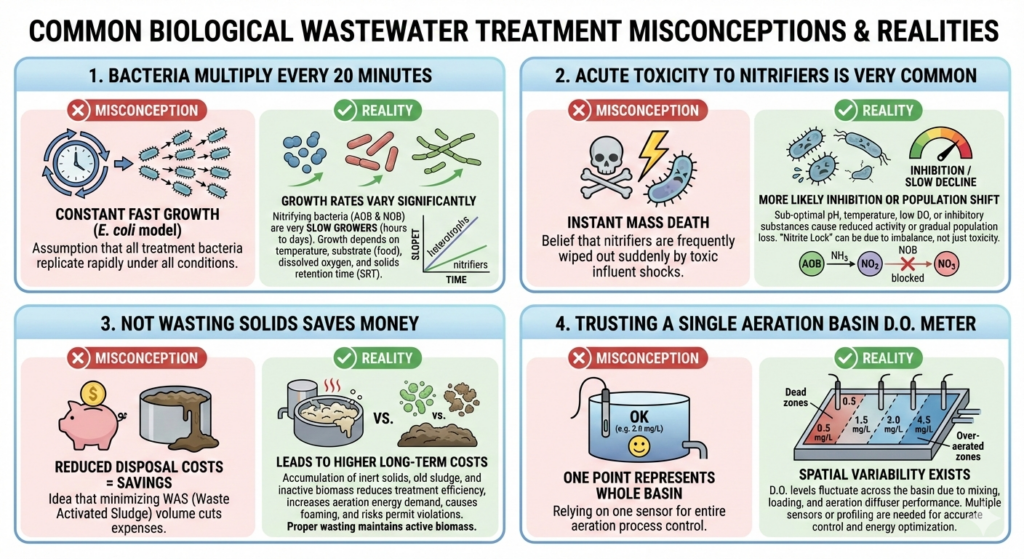
We’re breaking down common misconceptions about activated sludge, nitrification, and process control that might be costing you money and stability.
As wastewater professionals, we operate at the intersection of rigorous engineering and chaotic biology. Because managing a living ecosystem is inherently complex, our industry relies heavily on “rules of thumb” passed down from senior operators to rookies.
Many of these rules are gold. But some are outdated, oversimplified, or just plain wrong.
Relying on biological misconceptions can lead to wasted energy, process instability, and sleepless nights worrying about permit violations. It’s time to update our mental models.
Let’s unpack these four points and discuss how they affect your daily operations.
1. The Reality of Bacterial Growth Rates
The “20-minute rule” is derived from studying E. coli under perfect laboratory conditions with unlimited food and ideal temperature. Your aeration basin is not a perfect lab.
Your mixed liquor is a cage match between fast-growing heterotrophs (which eat carbon/BOD) and slow-growing autotrophs (nitrifiers like AOBs and NOBs).
If you lose your nitrifying population due to a washout event or a toxic hit, they will not bounce back in a shift. Depending on the temperature and your Solids Retention Time (SRT), repopulating nitrifiers can take weeks. Understanding these differing growth rates is fundamental to managing SRT correctly. You need an SRT long enough to keep the slow runners (nitrifiers) in the race before they are wasted out.
2. Inhibition vs. Toxicity
When ammonia numbers start creeping up on the effluent, the immediate reaction is often, “Something toxic came down the pipe and killed the bugs.”
While true acute toxicity happens, it’s statistically less likely than inhibition. Inhibition means the bacteria aren’t dead, they are just stressed and working slowly.
Before you go hunting for illicit discharges, check the basics. Are the AOBs and NOBs in a hostile work environment?
-
pH & Alkalinity: Nitrification consumes alkalinity. If your pH drops below 6.8, nitrification rates plummet.
-
Dissolved Oxygen: Nitrifiers are weak competitors for oxygen. If D.O. is low (<1.5 mg/L), heterotrophs will snatch it first.
Often, what looks like acute toxicity is actually a slow, chronic bleed of the nitrifier population due to poor environmental conditions over several SRT cycles.
3. The High Cost of Not Wasting
It’s tempting to reduce Waste Activated Sludge (WAS) rates to save on hauling costs or dewatering polymer. But this is false economy.
As sludge ages, a higher percentage of it becomes inert solids and cellular debris (endogenous decay). These old “freeloaders” don’t remove BOD effectively, but they still have endogenous oxygen demand. You end up pumping air into the basin just to keep useless solids.
Furthermore, an excessively high mixed liquor concentration overloads your secondary clarifiers, leading to high effluent TSS and potential permit violations. Regular, controlled wasting ensures a lean, hungry, active biomass that settles well and uses air efficiently.
4. Spatial Variability and D.O. Probes
If you have a 1-million-gallon aeration basin and only one D.O. probe located near the effluent weir, you are making decisions based on a tiny snapshot of reality.
Aeration basins are notoriously uneven. The inlet usually has high oxygen demand and low D.O., while the outlet might be saturated. There are dead zones in corners and hot spots directly over newer diffusers.
If your single probe reads 2.0 mg/L, half the basin might be at 0.5 mg/L (inhibiting nitrification) and the other half might be at 4.0 mg/L (wasting energy and shearing floc).
The fix: Use handheld D.O. profiles regularly to map your basin’s “hot” and “cold” spots. Don’t trust the single sensor until you verify what it represents in the wider context of the tank.
Conclusion
Biological wastewater treatment is tough enough without relying on faulty mental models. By understanding the actual behavior of your biomass rather than relying on generalized myths, you can run a more stable, efficient, and compliant plant.
What other wastewater myths do you hear regularly? Share them in the comments below!