
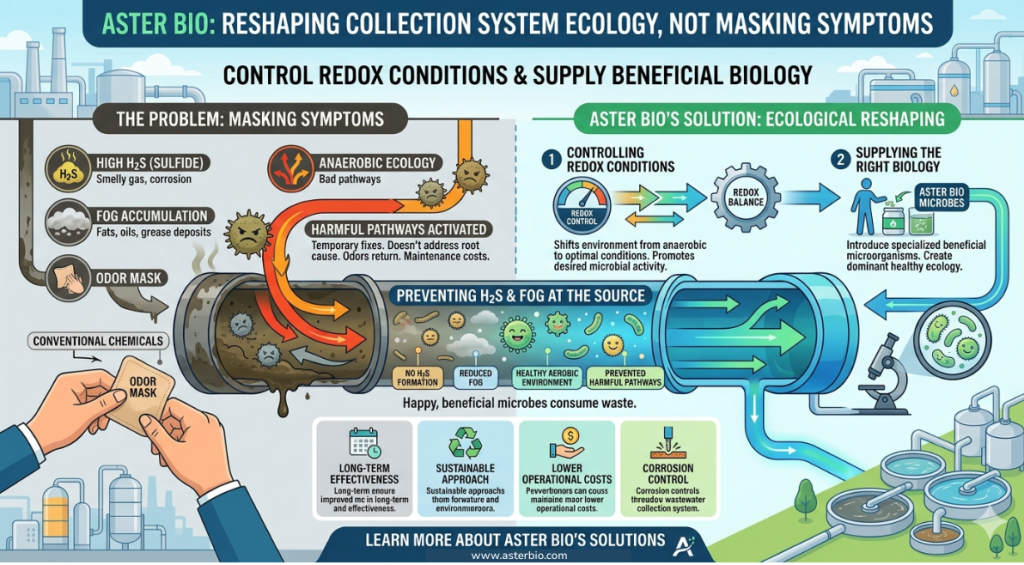
If you operate or maintain a wastewater collection system, you already know the “triple threat” that drives complaints and rehab budgets: odors, corrosion, and hydrogen sulfide (H2S). The trap is treating each symptom in isolation—chasing headspace readings, responding to the next hot spot, and spending more chemical just to get back to “normal.”
A practical way to get ahead of all three is to combine oxidation-reduction potential (ORP) monitoring with bioaugmentation. ORP is a leading indicator of when wastewater is drifting toward septicity (and sulfide generation), while bioaugmentation helps remove the upstream fuel—especially fats, oils, and grease (FOG)—that creates “septic pockets” and makes chemical programs feel like a treadmill.
- What ORP is really telling you in a collection system (and why it beats “after-the-fact” H2S readings)
- How low ORP drives odors and microbiologically influenced corrosion (MIC)
- Why FOG is the multiplier that turns chronic issues into emergencies
- How to pair ORP control + bioaugmentation for more stable results and lower total cost
ORP 101 for Collection Systems: Your “Early Warning” Signal
ORP is a single, fast field/online measurement (in millivolts) that reflects whether the wastewater environment is trending oxidizing (electron acceptors available) or reducing (septic). In practice, it helps you spot when a force main, wet well, or slow-moving trunk line is sliding into conditions where sulfate-reducing bacteria (SRB) can start generating sulfide.
- Positive ORP (roughly +100 mV to +600 mV): Oxidizing conditions; aerobic activity is favored and sulfide generation is typically suppressed.
- Low/negative ORP (about -100 mV to -400 mV): Reducing/septic conditions; SRB become active and convert sulfate to dissolved sulfide that can partition to HS Many operators use about -50 mV or higher as a practical “stay out of trouble” target to help prevent sulfide formation.
Why Measuring ORP Matters
Headspace H2S sensors tell you what has already escaped. ORP tells you what the wastewater is capable of producing before the gas shows up at a manhole, wet well, or odor control unit. With stable ORP feedback, you can tune nitrate or oxidizer dosing to maintain a protective buffer above the sulfide-forming range—instead of guessing based on complaints or grab samples.
When ORP Stays Low: Odors and Crown Corrosion Follow
If a segment runs reducing for long periods (force mains, long detention times, grease-coated walls), dissolved sulfide builds—and two predictable failures show up:
- Odors: “Rotten egg” H2S episodes that drive complaints—often worst at wet wells, siphons, and downstream drop structures.
- MIC (microbiologically influenced corrosion): Once H2S enters the headspace, sulfide-oxidizing biofilms on the pipe crown can convert it to sulfuric acid (H2SO4), accelerating concrete and metal loss and shortening asset life.
Operator takeaway: Don’t wait for gas. Use ORP to keep the liquid phase out of the sulfide-forming zone (often targeting about > -50 mV in problem areas). That inhibits the biological pathway that creates H2S in the first place.
The More Sustainable Play: ORP Control + Bioaugmentation
Oxidizers (e.g., peroxide) and nitrate programs can raise ORP quickly, but they don’t change what’s living on the pipe wall—and they don’t remove grease. Bioaugmentation (adding selected bacteria and/or enzymes) is designed to shift the biology, so the system is less likely to go septic between dose points.
- Shifting the Microbial Population
Bioaugmentation introduces facultative organisms that perform well with dissolved oxygen and/or nitrate present. In other words, you’re promoting microbes that compete with SRB for food when you hold ORP in a favorable range—reducing the chance of sulfide production during long detention times. - Sludge and FOG Reduction
Many programs target FOG and settled organics. As deposits thin out, you remove habitat for anaerobic biofilms and improve mass transfer at the wall (where septicity often starts). The practical outcome is a collection system that holds ORP more steadily—and needs less “rescue” dosing. - Lowering Operational Costs
A chemical-only approach can work—but costs typically scale with the problem. If organics and grease keep accumulating, the dose often keeps creeping up just to maintain the same outcome.
- Lower chemical demand over time: Once a beneficial population is established, biology carries more of the load—so ORP targets can be maintained with less oxidizer/nitrate in many applications.
- Fewer emergencies: Reducing FOG buildup and slowing corrosion can mean fewer reactive jetting calls, fewer odor events, and longer rehab intervals.
At a Glance: Chemical-Only vs. ORP Control + Bioaugmentation
| Feature | Chemical Only | Bioaugmentation + ORP Control |
| Speed of Result | Immediate | Gradual to Permanent |
| Cost Profile | High (Continuous Chemical Spend) | Lower (Reduced Chemical + Bio-culture) |
| Infrastructure | High Corrosion Risk if under-dosed | Proactive Corrosion Inhibition |
| System Health | Treats Symptoms | Treats the Root Cause |
Bottom Line
If you can measure ORP, you can manage septicity with a lot more precision than “dose and hope.” And when you pair ORP control with bioaugmentation that targets pipe-wall deposits and FOG, you’re not just masking symptoms—you’re improving the underlying conditions that create sulfide, odors, and crown corrosion.
Question for you: In your system, is the bigger driver (1) force main detention time and downstream H2S spikes, or (2) chronic FOG loading (restaurant districts, grease-coated wet wells, frequent cleaning)?