
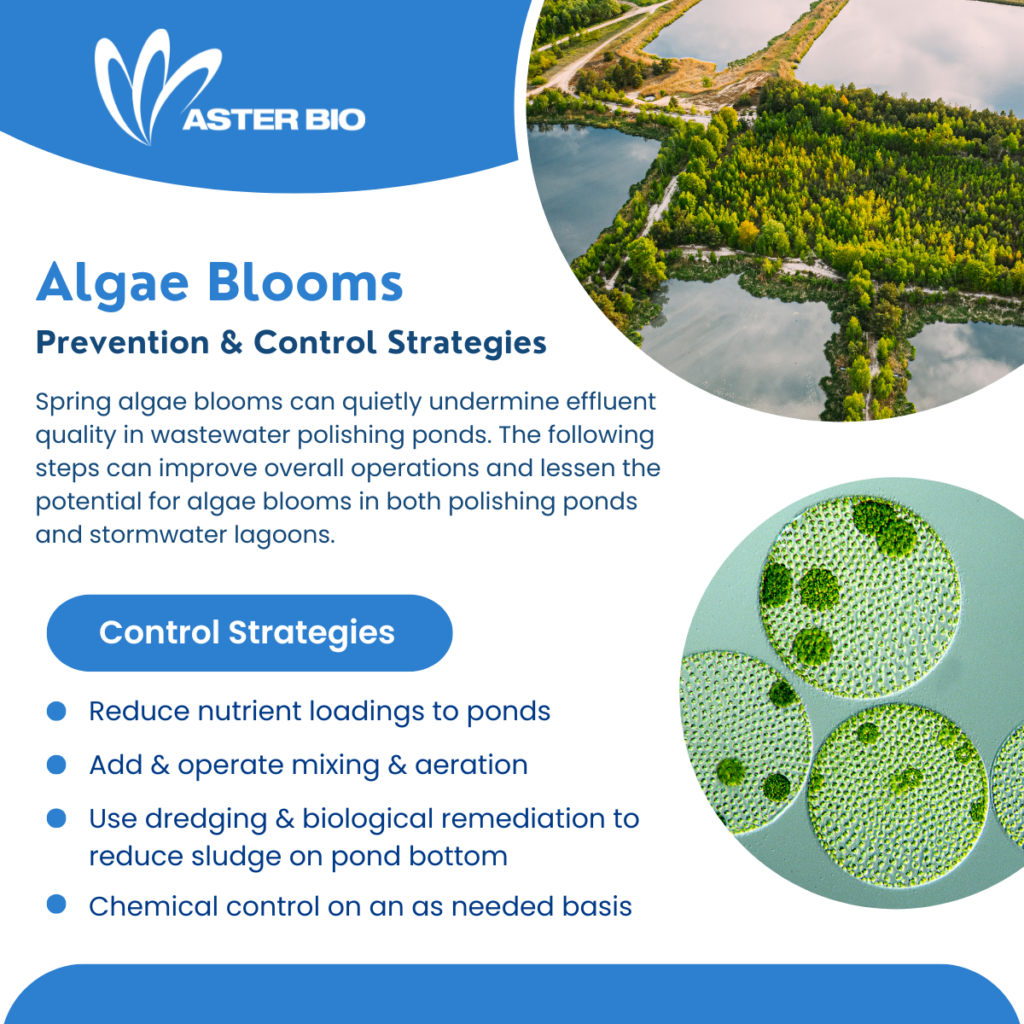
Spring algae blooms are a familiar challenge for many wastewater treatment facilities that operate polishing ponds—also known as maturation, tertiary, or finishing lagoons.
These shallow systems follow secondary treatment and rely on natural processes to further improve effluent quality by removing remaining nutrients, pathogens, and organics. Algae play a role in this process, but in the spring, conditions often favor problematic algae blooms.
As water temperatures rise, daylight increases, and residual nutrients remain available, algae can grow rapidly. The result is often elevated total suspended solids (TSS), higher pH, large day–night swings in dissolved oxygen, odor complaints, and, in some cases, permit compliance issues related to TSS, BOD, or nutrients.
While algae can be beneficial in facultative or stabilization ponds, excessive blooms in polishing ponds tend to work against effluent quality goals rather than support them.
Focus on Prevention, Not Just Reaction
The most effective long-term strategy for managing spring algae blooms is prevention. That means limiting nutrients—especially phosphorus, which is often the limiting factor—and disrupting the conditions that allow algae to dominate.
Spring is a critical window. Proactive measures taken early can significantly reduce the severity of blooms later in the season.
Key Strategies for Control and Prevention
- Reduce Nutrient Inputs Upstream
Start by minimizing the nutrients entering the polishing pond:
- Optimize upstream treatment processes to reduce residual nitrogen and phosphorus.
- Address internal nutrient release from bottom sediments or accumulated sludge, which commonly increases in spring as temperatures rise. While dredging is not always practical, mixing and biological sludge reduction can help limit sudden nutrient release that fuels algal growth.
- Increase Mixing and Aeration
Mixing and aeration are among the most reliable tools for algae control:
- Diffused aeration, mechanical mixers, or circulation systems help prevent thermal stratification and disrupt algal buoyancy.
- Improved mixing reduces light exposure, limits surface scums, and supports aerobic bacteria that compete with algae for nutrients.
- Consider Supplemental Control Methods
Additional tools may be appropriate depending on system size, regulatory constraints, and operational goals:
- Ultrasonic control systems can disrupt algae cells without chemical addition and are often used for continuous control in lagoons.
- Aquatic dyes, applied early in the season, reduce light penetration and limit photosynthesis (most practical for smaller ponds).
- Chemical algaecides, such as copper-based products, may be used selectively for active blooms but are generally not a long-term solution due to toxicity concerns, potential resistance, and regulatory limitations.
Practical Recommendations for Spring Operations
- Begin preventive actions—such as aeration startup and nutrient monitoring—in late winter or early spring, before water temperatures rise significantly.
- Track key indicators regularly, including TSS, pH (often an early signal of algal activity), dissolved oxygen, nutrients, and chlorophyll.
- Use a combination of strategies. No single approach eliminates algae entirely in nutrient-rich systems.
In polishing ponds, the objective is not to eliminate algae, but to maintain stable, low-TSS effluent. Prioritizing nutrient control and effective mixing typically delivers better long-term results than reactive algae-killing approaches.